
How to Create a Marketing Campaign Step by Step Guide

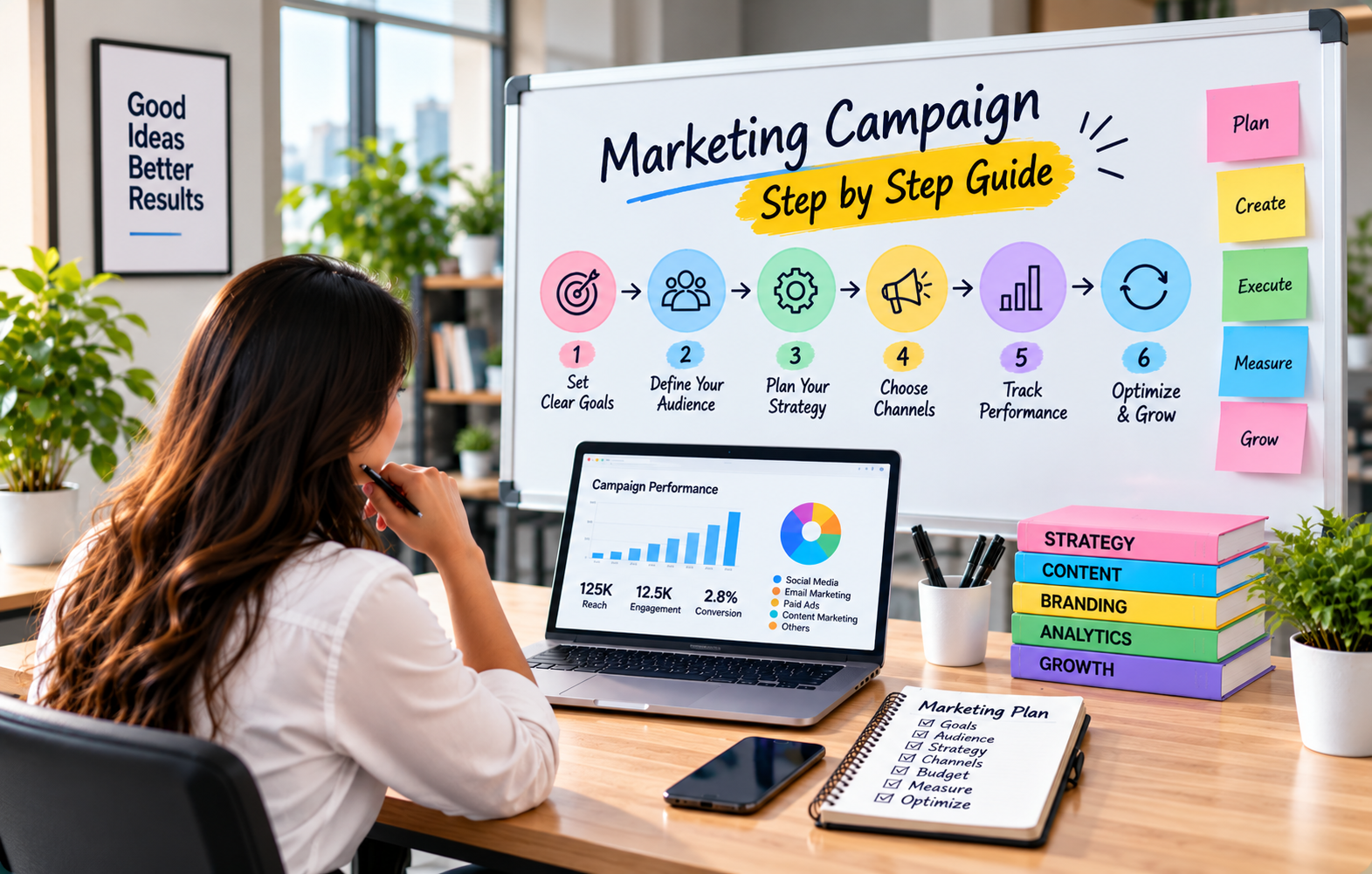
How Do You Create a Marketing Campaign?
To create a marketing campaign, start with a clear objective, define your target audience, research their needs, develop a relevant offer and message, choose the right marketing channels, set a realistic budget, define KPIs, prepare campaign assets, launch with accurate tracking, and optimize performance based on results. Each step should connect directly to the campaign goal and measurable business outcomes.
10 Steps to Create a Marketing Campaign
-
Define your campaign objective and decide what you want the campaign to achieve.
-
Identify your target audience using customer data, segmentation, and buyer personas.
-
Research your audience, market, and competitors to understand needs, gaps, and positioning.
-
Develop your offer, campaign message, and CTA based on the audience’s priorities.
-
Choose the right marketing channels based on audience behaviour, campaign goals, and budget.
-
Set your campaign budget across media, creative, tools, testing, and other execution costs.
-
Define KPIs and measurement criteria such as leads, conversions, revenue, ROI, or engagement.
-
Build the campaign timeline and assets, including ads, emails, landing pages, and content.
-
Launch, track, and test the campaign using reliable analytics and conversion tracking.
-
Analyze results and optimize performance by reviewing KPIs, identifying weak points, and applying the learnings to current and future campaigns.
What Is a Marketing Campaign?
A marketing campaign is a coordinated set of marketing activities designed to achieve a defined objective with a specific target audience within a set timeframe. It uses a consistent message across selected marketing channels and is measured against clear outcomes such as leads, sales, conversions, engagement, or brand awareness.
Unlike ongoing marketing activity, a campaign has a clear beginning and end, a specific purpose, and measurable performance criteria. Strong campaigns align the objective, audience, message, channels, budget, and KPIs so every activity supports the same business goal.
Marketing Campaign vs. Marketing Strategy vs. Marketing Plan
A marketing strategy defines the long-term direction for reaching and converting customers. A marketing plan turns that strategy into organized activities, budgets, channels, and timelines. A marketing campaign is a focused, time-bound initiative designed to achieve a specific objective within that broader plan.
|
Factor |
Marketing Strategy |
Marketing Plan |
Marketing Campaign |
|
Purpose |
Defines how marketing will support business goals |
Organizes how the strategy will be executed |
Achieves a specific marketing objective |
|
Scope |
Broad, long-term direction |
Multiple marketing activities and channels |
Focused initiative or promotion |
|
Timeframe |
Long term |
Usually quarterly or annual |
Fixed campaign period |
|
Output |
Positioning, audience, value proposition, and strategic direction |
Activities, budgets, channels, responsibilities, and timelines |
Campaign message, assets, channels, KPI,s and results |
|
Example |
Build awareness among Indian SMEs |
Use SEO, LinkedIn, ema,il and paid search throughout the year |
Run a six-week lead-generation campaign for a new service |
In simple terms: the strategy sets the direction, the plan organizes the work, and the campaign executes a specific goal. Marketing campaign planning should therefore remain aligned with the broader marketing strategy rather than operate as an isolated activity.
How to Create a Marketing Campaign in 10 Steps
Effective marketing campaign planning follows a sequence: Objective → Audience → Offer → Channel → KPI → Execution → Optimization. Each decision should support the next, so the campaign stays focused on a measurable business outcome rather than disconnected marketing activities.
1. Define Your Campaign Objective
Start by deciding exactly what the campaign should achieve. A clear campaign objective gives the team a shared direction and determines how success will be measured.
Common objectives include:
-
increasing brand awareness
-
generating qualified leads
-
driving sales
-
launching a new product or service
-
improving customer retention
-
increasing engagement
Turn the objective into a SMART goal: specific, measurable, achievable, relevant, and time-bound. For example, instead of “generate more leads,” define a target such as “generate 300 qualified demo requests during the eight-week campaign.”
Choose the objective before selecting KPIs. The KPI should measure progress toward the business goal; the campaign should not be designed around whichever metric is easiest to track.
2. Identify Your Target Audience and Buyer Persona
A campaign becomes more relevant when it is designed for a clearly defined audience rather than “everyone.”
Think about audience definition at three levels:
Target market → Audience segment → Campaign persona
The target market is the broader group you can serve. An audience segment narrows that group based on shared characteristics. A campaign persona represents the type of individual the campaign needs to influence.
Consider:
-
demographics and location
-
behaviours and interests
-
needs and pain points
-
purchase motivations
-
buying stage
-
preferred marketing channels
For example, a B2B software campaign might target Indian SMEs broadly, narrow the audience to finance leaders at growing companies, and build messaging around a persona concerned with reducing manual reporting.
3. Research Your Audience, Market and Competitors
Good campaigns are based on evidence, not assumptions. Research helps identify what customers value, how they describe their problems, and where competing campaigns leave gaps.
Useful research sources include:
-
customer interviews and surveys
-
website and campaign analytics
-
CRM and customer data
-
search behaviour
-
customer reviews
-
sales-team insights
-
competitor messaging and positioning
Look for recurring customer questions, objections, motivations, and language. Then review competing offers to understand how others position similar solutions.
The goal is not to copy competitors. It is to identify an angle, message, offer, or experience that makes your campaign more useful and relevant to the intended audience.
4. Develop the Campaign Offer, Message, and CTA
Translate your audience research into a clear reason to act.
A useful framework is:
Audience problem → Value proposition → Proof → Offer → CTA
First, identify the problem the audience wants solved. Explain the value your product, service, or idea provides. Support the message with credible proof where available, present a relevant offer, and finish with one clear call to action.
For example:
- Problem: Manual reporting takes too much time.
- Value: Automate recurring reports.
- Proof: Demonstrate the workflow or provide a real customer example.
- Offer: Free product demo.
- CTA: “Book a demo.”
Keep the core campaign message consistent across channels while adapting the format to each platform.
5. Choose the Right Marketing Channels
Do not choose channels simply because they are popular. Select them according to:
Objective + Audience behaviour + Message format + Budget + Measurement capability
For example:
|
Channel |
Often useful for |
|
Google Search |
Capturing existing demand |
|
SEO/content |
Education and long-term discovery |
|
Instagram/Facebook |
Visual discovery, awareness and retargeting |
|
YouTube |
Demonstrations and educational content |
|
|
B2B audiences and professional targeting |
|
|
Nurturing leads and existing customers |
|
|
Direct communication where appropriate |
|
Influencers |
Audience access and social proof |
|
Offline/print |
Relevant local or specialised audiences |
You do not need every channel. A smaller combination of well-selected channels is usually easier to coordinate, measure, and optimize.
6. Set Your Marketing Campaign Budget
Your campaign budget should reflect the objective, available resources, selected channels, and expected execution requirements.
Plan costs across categories such as:
-
media and advertising
-
creative and content production
-
marketing technology and tools
-
landing-page development
-
agencies or freelancers
-
campaign testing
-
contingency
For example, an Indian business with a ₹3 lakh campaign budget might divide spending across media, creative production, landing-page work, analytics, and testing based on its campaign priorities. This is an illustrative allocation, not a universal benchmark.
Reserve enough budget for experimentation instead of committing everything before you know which audience, message, or channel performs best.
7. Define KPIs and Your Measurement Plan
Select one primary KPI that directly reflects the campaign objective, then use supporting metrics to diagnose performance.
|
Objective |
Primary KPI |
Supporting metrics |
|
Awareness |
Reach or qualified exposure |
Impressions, branded search |
|
Lead generation |
Qualified leads |
CPL, conversion rate |
|
Sales |
Revenue or conversions |
CPA, ROAS |
|
Engagement |
Meaningful engagement |
CTR, shares, interaction |
|
Retention |
Repeat purchase or retention |
Repeat revenue, churn |
Do not treat every metric as equally important. A campaign can generate high impressions or clicks and still fail if its primary objective is qualified sales.
Before launch, confirm the tracking method, conversion events, attribution approach, baseline performance, target, and reporting frequency.
8. Build the Campaign Timeline and Assets
Turn the strategy into an execution plan with clear phases:
Planning → Production → Pre-launch → Launch → Optimization → Review
List every required asset, deadline, and owner. Depending on the campaign, assets may include:
-
ads
-
landing pages
-
emails
-
social posts
-
videos
-
sales materials
-
lead forms
-
campaign reports
Build backwards from the launch date and allow time for approvals, revisions, technical setup, and quality checks. This prevents creative production or tracking issues from delaying the campaign.
9. Launch, Track and Test the Campaign
Before going live, verify that the campaign can be measured correctly.
Check:
-
tracking and analytics
-
UTM parameters
-
links and forms
-
conversion events
-
landing pages
-
campaign naming conventions
-
creative quality
-
mobile experience
Once the campaign is running, monitor performance regularly and use controlled tests to improve results. A/B testing can compare variables such as headlines, CTAs, creative, landing-page layouts, or audience segments.
Avoid changing several major variables simultaneously, because doing so makes it harder to understand what actually caused the performance change.
10. Analyze Results, Calculate ROI and Optimize
Campaign optimization happens at two levels.
During the campaign, monitor performance and improve weak areas such as targeting, creative, landing pages, bids, or offers.
After the campaign, compare actual results against the original objective and document what should change next time.
Review:
-
goal versus actual performance
-
conversion rate
-
cost per lead or acquisition
-
ROAS
-
ROI
-
channel performance
-
creative performance
-
audience performance
A commonly used ROI framework is:
ROI = (Return − Campaign Cost) ÷ Campaign Cost × 100
Clearly define what counts as “return” and which costs are included before using the result for comparisons.
Finally, document the strongest audiences, channels, messages, assets, and lessons. A campaign becomes more valuable when its findings improve the next marketing decision.
Marketing Campaign Example
Consider an Indian mid-sized software company launching a new invoicing tool for small businesses with a ₹4 lakh campaign budget.
The campaign could be structured like this:
-
Objective: Generate qualified demo requests during an eight-week launch campaign.
-
Audience: Small-business owners and finance managers in India who still rely on manual invoicing or spreadsheets.
-
Message: Save time, reduce billing errors, and simplify invoice management with one easy-to-use tool.
-
Channels: Google Search to capture active demand, LinkedIn for B2B targeting, email for lead nurturing, and retargeting ads for visitors who do not convert immediately.
-
Budget: Allocate spend across paid media, creative assets, landing-page development, email automation, analytics, and testing rather than placing the full budget into advertising alone.
-
KPIs: Qualified demo requests as the primary KPI, supported by conversion rate, cost per lead, channel-level performance, and campaign ROI.
-
Timeline: Two weeks for planning and production, four weeks for launch and optimization, and two weeks for continued testing and post-campaign analysis.
This example shows how each campaign decision connects to the next: the objective shapes the audience, the audience influences the message, the message affects channel choice, and the objective determines the KPI.
Common Marketing Campaign Mistakes to Avoid
Even a well-funded campaign can underperform if the planning and measurement are weak. Common mistakes include:
-
Starting with channels instead of goals: Decide what the campaign must achieve before choosing platforms or tactics.
-
Targeting everyone: Broad targeting often weakens the message and reduces relevance.
-
Using too many objectives: Prioritize one primary campaign goal and use supporting goals only where necessary.
-
Using an unclear CTA: Make the next action obvious, specific, and consistent with the campaign objective.
-
Choosing channels based on popularity: Select channels according to audience behaviour, intent, budget, and measurement capability.
-
Setting a budget without a measurement plan: Know what success looks like before spending begins.
-
Tracking only vanity metrics: Impressions and clicks can be useful, but they should not replace outcome-based KPIs such as qualified leads, conversions, revenue, or retention.
-
Changing too many variables at once: Test changes systematically so you can identify what actually affected performance.
-
Waiting until the campaign ends to measure results: Monitor performance during the campaign and optimize while there is still time to improve outcomes.
-
Failing to document learnings: Record what worked, what failed, and why so future campaigns can start with better evidence.
The most effective campaign optimization comes from disciplined measurement: set the objective, track the right KPI, test carefully, and carry the learning forward.
Conclusion
Creating a successful marketing campaign starts with clear goals, a defined target audience, and the right channels. Plan your budget, create relevant content, track key metrics, and optimize based on results. A data-driven approach helps improve engagement, maximize ROI, and achieve long-term marketing success.
Related Blogs >>> 15 Benefits of Content Marketing You'd Regret Missing
>>> 20 Best Business Directory Websites to List Your Business


Leave a Comment
Your email address will not be published. Required fields are marked *