
Local SEO Services for Small Businesses: How to Get More Local Customers

- Introduction
- Why Is Local SEO Important for Small Businesses?
- How Does Local SEO Work for Small Businesses?
- What Do Local SEO Services Include?
- Google Business Profile Optimization for Small Businesses
- Local Keyword Research: How to Target Nearby Customers
- Local SEO for Different Types of Small Businesses
- Local Citations, Business Listings and NAP Consistency
- How to Get More Google Reviews and Build Local Trust
- Local SEO vs Traditional SEO: What's the Difference?
- How Much Do Local SEO Services Cost in India?
- How to Choose the Best Local SEO Company for Your Small Business
- How to Measure Local SEO Performance and Business Growth
Introduction
Small businesses often struggle to attract local customers because competing with established brands, reaching nearby audiences and building online visibility can be challenging. Even when a business offers quality products or services, potential customers may choose competitors simply because they appear more prominently in Google Search and Google Maps.
This is where local SEO services for small businesses become valuable. Local SEO helps businesses improve their online presence so nearby customers can find them when searching for relevant products or services. It involves optimizing Google Business Profile, targeting location-based keywords, managing online reviews, building local citations and improving website content.
For example, when someone searches for a dentist in Jaipur, a clothing shop in Bikaner, or a restaurant near their location, local SEO helps relevant businesses improve their chances of appearing in local search results.
Whether you run a retail shop, clinic, restaurant, coaching centre, or home service business, investing in local SEO can help you reach potential customers, build credibility, and generate more local enquiries.
Why Is Local SEO Important for Small Businesses?
Local SEO matters for small businesses because it helps them reach potential customers actively searching for products or services nearby. Instead of competing with large brands nationwide, businesses can focus on attracting customers within their service areas.
For example, when someone searches for a bakery in Jaipur or a dentist in Bikaner, Google displays relevant local businesses based on factors such as relevance, distance, and prominence. Having a well-optimized online presence can improve a business's chances of appearing in these results.
Key Benefits of Local SEO for Small Businesses
-
Better Local Visibility: Helps businesses appear in relevant local searches and Google Maps results.
-
More Relevant Customers: Connects businesses with people searching for nearby products and services.
-
Improved Trust: Accurate business information, genuine customer reviews and updated profiles help build credibility.
-
More Customer Enquiries: Makes it easier for potential customers to call, visit a website or request directions.
-
Cost-Effective Marketing: Provides an opportunity to attract organic local traffic without depending entirely on paid advertising.
-
Competitive Advantage: Helps smaller businesses compete with established businesses in their local markets.
Examples of Local SEO for Indian Businesses
Consider a few practical examples:
- clothing store in Bikaner can target searches such as "clothing shops in Bikaner" to reach nearby shoppers.
- A dental clinic in Jaipur can optimize its Google Business Profile to improve visibility for local dental searches.
- A restaurant in Delhi can use local keywords, updated business information and customer reviews to attract people searching for nearby dining options.
How Does Local SEO Work for Small Businesses?
Local SEO works by optimizing a business's online presence so search engines can understand its services, location and relevance to nearby customers. When someone searches for a local product or service, Google considers several factors to display relevant businesses in Search and Google Maps.
Google Local Search Results and Maps
Google displays local businesses in different formats, including the Google Local Pack (a group of business listings often shown with a map) and Google Maps results.
For example, someone searching for "best salon in Jaipur" may see nearby salons with their addresses, ratings, contact details, and directions.
Three Main Local Ranking Factors
Google identifies three primary factors that influence local search rankings:
-
Relevance: How closely a business profile matches what someone is searching for.
-
Distance: How far the business is from the searcher's location or the location mentioned in the search.
-
Prominence: How well-known a business is, considering information such as reviews, links and online presence.
Businesses cannot directly control every ranking factor, particularly distance, but they can improve their relevance and prominence through consistent optimization.
Website Signals and Business Information
Google also uses information from a business website and other online sources to understand its services and location. Important elements include:
-
Relevant local keywords in website content.
-
Accurate business name, address, and phone number.
-
Mobile-friendly website experience.
-
Consistent business information across directories.
-
Relevant local links and customer reviews.
How Customers Move from Search to Enquiry
A typical local customer journey looks like this:
-
Local Search
A customer searches for a nearby product or service.
-
Business Discovery
They find relevant businesses through Google Search or Maps.
-
Business Evaluation
They compare reviews, services, photos, prices, and locations.
-
Customer Action
They call, visit the website, request directions, or contact the business.
By optimizing each stage, small businesses can make it easier for nearby customers to discover their services and take the next step.
What Do Local SEO Services Include?
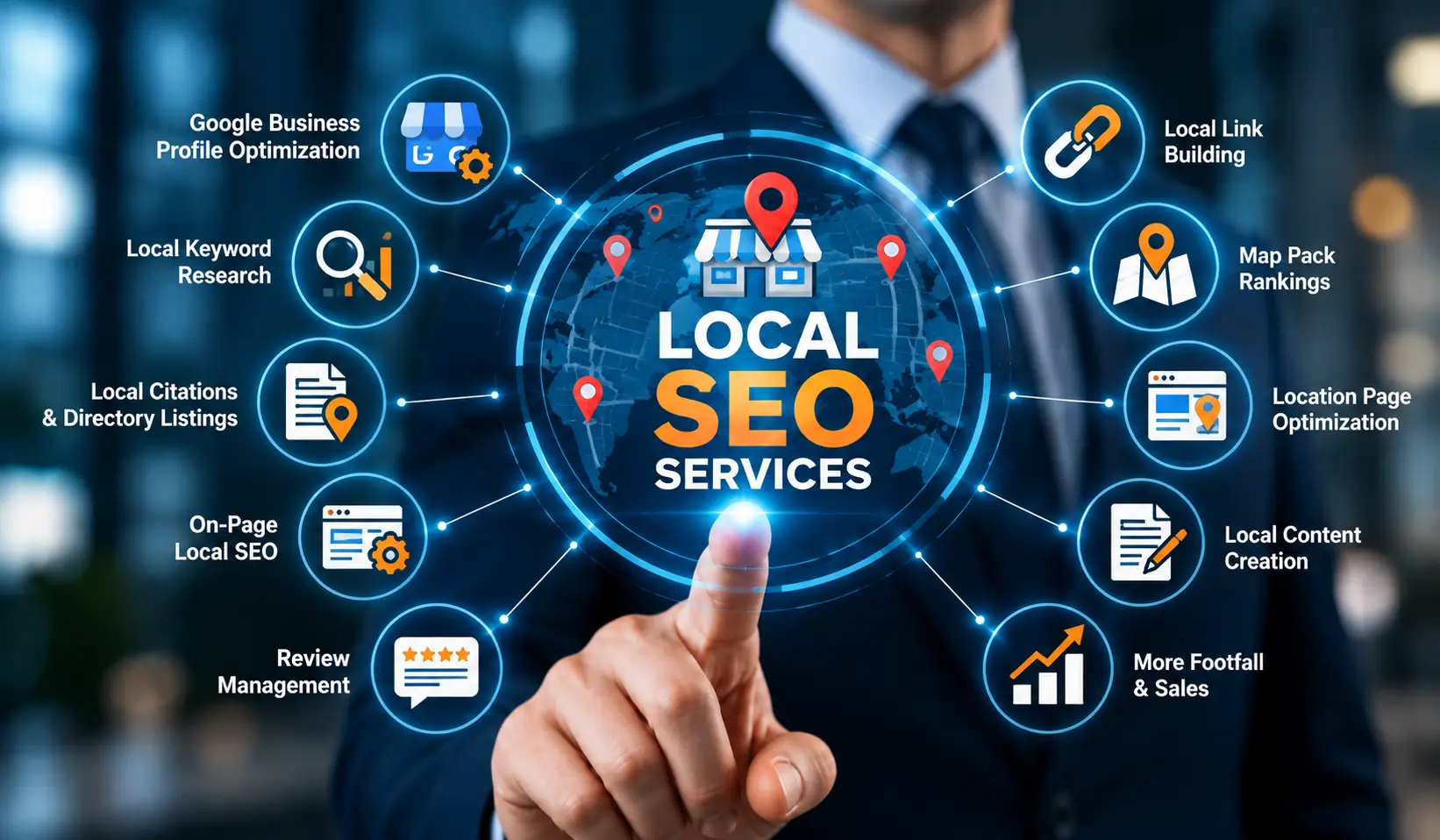
Local SEO services include different optimization activities that help small businesses improve their visibility in local search results, attract nearby customers and generate more enquiries. A professional local SEO strategy focuses on the following areas:
1. Local SEO Audit and Competitor Analysis
An SEO audit identifies issues affecting local search visibility, including incorrect business information, website problems and missing optimization opportunities. Competitor analysis helps understand how other local businesses attract customers and where improvements are needed.
2. Local Keyword Research
Local keyword research identifies the search terms potential customers use to find nearby businesses. It includes location-based keywords such as "plumber in Jaipur," "salon in Bikaner," and "digital marketing agency in Delhi."
3. Google Business Profile Optimization
Optimizing Google Business Profile helps customers discover accurate business information through Google Search and Maps. It includes business categories, descriptions, services, contact details, photos, operating hours and profile updates.
4. On-Page Local SEO
On-page SEO improves website content and structure to target relevant local searches. It includes optimizing title tags, meta descriptions, headings, internal links and service-related content with appropriate location keywords.
5. Local Landing Page Optimization
Location-specific landing pages help businesses target customers in different cities or service areas. Each page should provide relevant services, location information and useful content instead of repeating identical content with different city names.
6. Citation Building and NAP Consistency
Local citations are online mentions of a business's name, address and phone number (NAP). Listing accurate and consistent information on relevant directories such as Justdial and Sulekha helps customers find the business and verify its details.
7. Review and Reputation Management
Review management involves encouraging genuine customer feedback, responding to reviews and monitoring online reputation. Positive, authentic reviews can help potential customers evaluate a business before contacting it.
8. Local Link Building
Local link building focuses on earning relevant links from local websites, business associations, community organizations, and industry-related publications. These links can strengthen website authority and improve local relevance.
9. Technical SEO and Mobile Optimization
Technical SEO ensures that search engines can crawl and understand a website properly. It includes improving page speed, mobile usability, indexing, website security and structured data where appropriate.
10. Performance Tracking and Reporting
Regular reporting helps businesses understand whether their local SEO activities are producing meaningful results. Important metrics include:
-
Google Business Profile performance.
-
Local keyword visibility.
-
Customer calls and direction requests.
-
Website enquiries and conversions.
Google Business Profile Optimization for Small Businesses
Google Business Profile (GBP) optimization helps small businesses manage how they appear on Google Search and Google Maps. A properly maintained profile makes it easier for potential customers to find business details, explore services, read reviews and contact the business.
Here are the key steps involved in optimizing a Google Business Profile.
1. Profile Setup and Verification
Start by creating or claiming your Google Business Profile and completing the verification process. Provide accurate information, including your business name, address or service area, phone number, website and operating hours.
2. Choose the Right Business Categories
Select the most relevant primary business category to describe your main service. Add secondary categories only when they accurately represent other services your business provides.
For example, a dental clinic may choose "Dentist" as its primary category and add relevant secondary categories for its additional specialties.
3. Optimize Business Description and Services
Write a clear business description explaining what your company offers, where it operates and what customers can expect. Add relevant products or services with accurate descriptions. Avoid unnecessary keyword repetition.
4. Add Photos, Posts and Business Updates
Regularly update your profile with genuine business photos, service images, product pictures and relevant announcements. Google Business Profile posts can also communicate offers, events and important updates to potential customers.
5. Manage Customer Reviews
Encourage genuine customers to share their experiences. Respond professionally to both positive and negative reviews, address customer concerns and avoid purchasing fake reviews or offering incentives in exchange for positive feedback.
Common Google Business Profile Optimization Mistakes
- Small businesses should avoid these mistakes:
-
Using incorrect business names or addresses.
-
Selecting irrelevant business categories.
-
Adding unnecessary keywords to the business name.
-
Leaving important business information incomplete.
-
Uploading misleading or unrelated photos.
-
Ignoring customer reviews.
-
Creating duplicate business profiles.
- Providing outdated operating hours.
Local Keyword Research: How to Target Nearby Customers
Local keyword research helps small businesses identify the search terms people use when looking for nearby products and services. Targeting relevant location-based keywords helps businesses reach potential customers in specific cities, neighbourhoods, and service areas.
1. Location-Based Keyword Research
Start by identifying the products or services your business offers and the locations you want to target. Use keyword research tools such as Google Keyword Planner, Google Search suggestions, and Google Search Console to discover relevant search terms.
2. Service + City and Service + Area Keywords
Combine your main services with relevant city and neighbourhood names to identify local search opportunities.
Examples:
-
Dentist in Jaipur
-
Digital marketing agency in Delhi
-
AC repair services in Bikaner
-
Salon in Vaishali Nagar
-
Best restaurant in Civil Lines
These keywords help businesses target customers searching for specific services in their areas.
3. Target Near-Me Searches
People frequently use phrases such as "near me," "nearby," and "open now" when looking for local businesses. Optimize your website and Google Business Profile with accurate business information and relevant service details to improve your chances of appearing in these searches.
Avoid creating unnecessary pages just to target variations of "near me."
4. Understand Search Intent and Map Keywords
Not every local keyword indicates the same customer requirement. Map keywords according to what users want to achieve.
|
Keyword example |
Search intent |
|---|---|
|
What is local SEO? |
Informational |
|
Best dentist in Jaipur |
Commercial |
|
Dentist near me |
Local / Transactional |
|
AC repair in Bikaner |
Transactional |
|
Local SEO packages India |
Commercial |
Prioritize keywords that indicate a genuine need for your products or services.
5. Examples for Indian Small Businesses
- Clothing stores: Boutique in Jaipur, ladies' clothing shop in Bikaner.
- Restaurants: South Indian restaurant in Delhi, family restaurant in Jaipur.
- Healthcare: Dental clinic in Jodhpur, physiotherapist in Bikaner.
- Home services: Electrician in Jaipur, plumbing services in Delhi.
- Education: Coaching centre in Kota, computer classes in Bikaner.
Local SEO for Different Types of Small Businesses
Local SEO strategies vary depending on the products or services a business offers and the customers it wants to reach. Targeting industry-specific keywords, optimizing Google Business Profile, and creating relevant local content can help different businesses attract nearby customers.
1. Local SEO for Retail Shops
Retail shops can target location-based searches related to their products and store locations. Optimizing business listings, adding product photos, collecting customer reviews, and maintaining accurate opening hours can improve local visibility.
2. Local SEO for Restaurants and Cafes
Restaurants and cafes can target searches such as "best restaurant in Jaipur" or "cafe near me." Menu information, food photos, customer reviews, location details and updated business hours help customers discover and evaluate dining options.
3. Local SEO for Clinics and Healthcare Providers
Clinics can optimize their websites and business profiles for relevant treatments, specialties and locations. Accurate doctor information, appointment details and genuine patient reviews can help people find suitable healthcare providers. Healthcare-related claims should remain accurate and professionally verified.
4. Local SEO for Coaching Centres
Coaching institutes can target searches related to courses, subjects, exams and locations. Course-specific landing pages, faculty information, admission details and student feedback can help attract students searching for local educational opportunities.
5. Local SEO for Real Estate Businesses
Real estate agencies can target location-specific searches such as "property dealer in Jaipur" or "flats for sale in Bikaner." Optimizing property pages, service areas and business information helps connect agencies with potential buyers and sellers.
6. Local SEO for Home Service Providers
Electricians, plumbers, AC repair technicians and cleaning companies can target service-based local keywords. Clearly mentioning service areas, contact details, operating hours and available services helps customers find and contact nearby providers.
7. Local SEO for Professional Services
Lawyers, accountants, consultants and digital marketing agencies can improve local visibility through service-specific pages, professional credentials, accurate business listings and relevant client reviews.
Local Citations, Business Listings and NAP Consistency
Local citations are online mentions of a business's name, address, and phone number (NAP) across directories, websites, and business listing platforms. They help customers find business information and verify that a company operates at a particular location.
1. What Are Local Citations?
Local citations are business listings that display important contact and location details. They can appear on search engines, online directories, social platforms, and industry-specific websites.
2. Maintain Consistent NAP Information
NAP stands for Name, Address, and Phone Number. Small businesses should maintain accurate and consistent details across their website and online listings.
For example, if a business uses one phone number on Google Business Profile and another on Justdial, customers may become confused. Consistent information makes business details easier to verify.
3. List Your Business on Relevant Platforms
Indian small businesses can consider relevant platforms such as:
-
Google Business Profile: Helps businesses appear in Google Search and Maps.
-
Bing Places: Provides business information for Bing search users.
-
Justdial: Connects customers with local businesses and service providers.
-
Sulekha: Helps users discover local service professionals.
-
Industry-specific directories: Provide additional visibility within relevant business categories.
Choose platforms that are relevant to your industry and target audience rather than submitting your business to every available directory.
4. Use Industry-Specific Directories
Industry-specific listings can help businesses reach more relevant audiences. For example, restaurants can explore food-related directories, while healthcare providers can consider suitable medical directories.
Always check the platform's credibility and listing requirements before submitting business information.
5. Manage Duplicate and Outdated Listings
Duplicate or outdated listings can confuse customers and create inconsistent business information. Regularly review your business listings to:
- Update changed addresses and phone numbers.
- Correct outdated operating hours.
- Remove or resolve duplicate listings.
- Update business names and website links.
- Maintain accurate service categories.
How to Get More Google Reviews and Build Local Trust
Google reviews help potential customers understand other people's experiences with a business before making a decision. Genuine customer feedback can build trust, strengthen online reputation and help small businesses stand out in local search results.
1. Use Ethical Review Collection Methods
Ask customers to share honest feedback after purchasing a product or completing a service. You can request reviews through follow-up emails, invoices, SMS messages or in-person conversations.
Make the process simple by sharing your direct Google review link or QR code. Never pressure customers to leave positive reviews.
2. Send Review Requests Through WhatsApp
WhatsApp is a convenient way for Indian small businesses to request customer feedback. Send a short, personalized message after a successful purchase or service.
For example:
Hi [Customer Name],
Thank you for choosing [Business Name]! We hope you had a great experience with us.
We would appreciate it if you could share your honest feedback on Google. Your review helps us improve our services and helps other customers discover our business.
Review here: [Google Review Link]
Thank you for your support!
3. Respond to Positive and Negative Reviews
Responding to reviews shows that your business values customer feedback.
-
Positive reviews: Thank customers for their feedback and appreciate their support.
-
Negative reviews: Respond professionally, acknowledge the concern and offer an appropriate solution.
-
Unclear reviews: Politely request more information to understand the customer's experience.
Avoid arguments or sharing customers' private information in public responses.
4. Manage Your Online Reputation
Regularly monitor reviews across Google and other relevant business platforms. Identify recurring customer complaints, address service issues, and use genuine feedback to improve the customer experience.
5. Why Should You Avoid Fake Reviews?
Buying reviews, posting fake feedback or offering incentives in exchange for positive reviews can violate Google's policies. Such practices can damage customer trust and put your business profile at risk.
Local SEO vs Traditional SEO: What's the Difference?
Local SEO and traditional SEO both improve a website's visibility in search engines, but they target different audiences and search behaviours. Local SEO focuses on attracting customers from specific geographic areas, while traditional SEO targets a broader audience regardless of location.
Key Differences Between Local SEO and Traditional SEO
|
Comparison |
Local SEO |
Traditional SEO |
|---|---|---|
|
Target audience |
Nearby customers |
National or global audience |
|
Main focus |
Location-based searches |
Broader organic searches |
|
Google Maps |
Important optimization area |
Not a primary focus |
|
Keywords |
Service + city or area |
Industry and topic-based keywords |
|
Business profile |
Google Business Profile optimization |
Website optimization is central |
|
Citations |
Local business listings and NAP |
General backlink and authority building |
|
Main goal |
Local enquiries and visits |
Organic traffic and conversions |
1. Local Search Optimization
Local SEO improves visibility for searches with geographic intent, such as "salon in Jaipur" or "plumber near me." It focuses on business listings, location-specific website content, customer reviews and local relevance.
2. Traditional Organic SEO
Traditional SEO improves website rankings for broader searches through keyword research, quality content, technical SEO, backlinks and on-page optimization.
For example, a digital marketing company may target keywords such as "how SEO works" or "benefits of content marketing" to attract a wider audience.
3. Google Maps Visibility
Google Maps is an important part of local SEO because customers use it to discover nearby businesses, compare reviews, check locations, and get directions. Traditional SEO primarily focuses on improving visibility in regular organic search results.
4. When Do Small Businesses Need Both?
Small businesses often benefit from combining both approaches.
For example, a Jaipur-based dental clinic can use local SEO to attract nearby patients while traditional SEO helps its website rank for informational searches about dental treatments.
How Much Do Local SEO Services Cost in India?
The cost of local SEO services in India depends on business location, industry competition, number of locations and the optimization work required. Small businesses can choose between managing SEO themselves, hiring a freelancer or working with a professional agency.
1. Factors Affecting Local SEO Pricing
Several factors influence the cost of local SEO:
-
Business Location: Competitive cities may require more optimization than less competitive local markets.
-
Industry Competition: Industries such as healthcare, real estate and legal services often require more effort.
-
Number of Locations: Businesses targeting multiple cities or branches need additional optimization.
-
Website Condition: Technical issues and missing location pages can increase the workload.
-
Service Requirements: Content creation, citation building, link building and ongoing profile management affect pricing.
2. DIY vs Freelancer vs Agency Costs
The following are indicative monthly budget ranges based on published Indian provider pricing guides for 2026.
|
SEO option |
Estimated monthly cost |
Suitable for |
|---|---|---|
|
DIY local SEO |
₹0 + your time |
Very small businesses |
|
Freelancer |
₹3,000–₹15,000 |
Single-location businesses |
|
Small SEO agency |
₹8,000–₹25,000 |
Small businesses needing ongoing support |
|
Specialized agency |
₹25,000–₹60,000+ |
Competitive and multi-location businesses |
Actual prices vary depending on deliverables and campaign complexity.
3. Single-Location vs Multi-Location Pricing
A business operating from one location generally needs less optimization than a company targeting multiple cities or branches.
For example, a salon targeting customers in Bikaner may need one optimized business profile and a focused local SEO campaign. A salon chain operating across Jaipur, Delhi, and Jodhpur needs location-specific pages, profile management, and separate performance tracking.
Multi-location campaigns therefore require additional resources and generally cost more.
4. What Should Be Included in a Local SEO Package?
Before purchasing a package, check whether it includes:
-
Local SEO audit and competitor research.
-
Google Business Profile optimization.
-
Local keyword research.
-
On-page and location page optimization.
-
Local citations and directory management.
-
Customer review monitoring.
-
Local link-building activities.
-
Monthly performance reports.
5. How to Evaluate Value Before Hiring an Agency
Don't select an SEO provider based only on the lowest price. Compare the actual work, experience, and reporting included in each proposal.
Ask the agency about its optimization process, monthly deliverables, reporting methods, and previous experience with similar businesses. Make sure you retain ownership of your website and Google Business Profile.
Avoid providers promising guaranteed first-page rankings, instant Google Maps visibility, or fake customer reviews.
How to Choose the Best Local SEO Company for Your Small Business
Choosing the right local SEO company can help small businesses improve search visibility, attract nearby customers and generate more enquiries. Before hiring an agency, evaluate its experience, services, communication, and optimization practices.
1. Check Relevant Industry Experience
Choose an agency that understands your industry, target audience, and local competition. Experience working with similar businesses can help it develop more relevant keyword strategies and optimization plans.
2. Evaluate Google Business Profile Expertise
Google Business Profile is an important part of local SEO. Make sure the agency understands profile optimization, business categories, customer reviews, service areas and local listing management.
3. Look for Transparent Deliverables
A reliable agency should clearly explain what its monthly SEO package includes, such as:
-
Local keyword research.
-
Website and Google Business Profile optimization.
-
Citation management.
-
Content and landing page improvements.
-
Local link-building activities.
-
Performance reporting.
4. Check Reporting and Communication
Ask how frequently the agency shares reports and which metrics it tracks. Reports should cover local visibility, website traffic, calls, enquiries and other relevant business performance indicators.
5. Prioritize Ethical SEO Practices
Choose an agency that follows search engine guidelines and focuses on genuine optimization. Avoid providers using fake reviews, spammy backlinks, misleading business information or keyword stuffing.
6. Watch for Warning Signs
Be cautious if an SEO company:
- Guarantees first position on Google.
- Promises instant ranking improvements.
- Offers hundreds of backlinks at extremely low prices.
- Uses fake Google reviews.
- Refuses to explain its SEO activities.
- Provides no regular performance reports.
- Demands unnecessary control over your website or business profile.
How to Measure Local SEO Performance and Business Growth
Measuring local SEO performance helps small businesses understand whether their optimization efforts are improving online visibility and generating actual customers. Instead of focusing only on rankings, track metrics that show how people discover your business, interact with your website, and become customers.
Here are the key metrics and tools to monitor:
1. Google Business Profile Performance
Use Google Business Profile performance data to understand how customers find and interact with your listing. Track:
-
Searches that show your business profile.
-
Views on Google Search and Maps.
-
Calls made directly from your profile.
-
Website clicks and direction requests.
2. Google Search Console
Google Search Console helps you monitor your website's performance in Google Search. Check:
-
Clicks and impressions from local search queries.
-
Average keyword positions.
-
Queries containing your city, area or service.
-
Pages receiving local organic traffic.
3. Google Analytics 4
Google Analytics 4 (GA4) helps you understand what visitors do after reaching your website. Monitor organic traffic, landing pages, engagement, enquiry form submissions and other important conversion events.
4. Calls and Direction Requests
For businesses that serve customers at a physical location, calls and direction requests are valuable indicators of local interest. Track these actions through your Google Business Profile and website to understand whether local visibility is encouraging potential customers to contact or visit you.
5. Website Enquiries and Conversions
Measure how many visitors take meaningful actions, such as:
-
Submitting contact forms.
-
Calling your business.
-
Clicking WhatsApp contact links.
-
Booking appointments.
-
Requesting quotes or service information.
6. Local Keyword Visibility
Track important location-based keywords such as "dentist in Jaipur" or "AC repair in Bikaner." Monitor ranking changes across relevant locations and devices. Remember that local rankings can vary by the searcher's location, so avoid relying on a single ranking check.
7. Measure Qualified Leads and ROI
The ultimate goal of local SEO is to generate relevant enquiries and business growth. Track how many leads turn into paying customers, the revenue they generate and the cost of your SEO investment.
You can calculate SEO return on investment (ROI) using:
For example, if your business generates ₹50,000 in revenue from local SEO and spends ₹10,000 on SEO, the ROI is 400%.