
Search Engine Marketing: Complete Guide, Types, Pros & Cons

- What Is Search Engine Marketing? Definition, Meaning, and Importance
- How Search Engine Marketing Works
- Why Is Search Engine Marketing Important?
- Search Engine Marketing vs Traditional Digital Marketing
- The Search Engine Business Model: How Search Engines Make Money
- Search Engines Ratio: Understanding Market Distribution
- Advantages of Search Engine Marketing
- Disadvantages and Limitations of Search Engine Marketing
- Is Search Engine Marketing Still Important in 2026?
- How Businesses Can Build an Effective Search Engine Marketing Strategy
What Is Search Engine Marketing? Definition, Meaning, and Importance
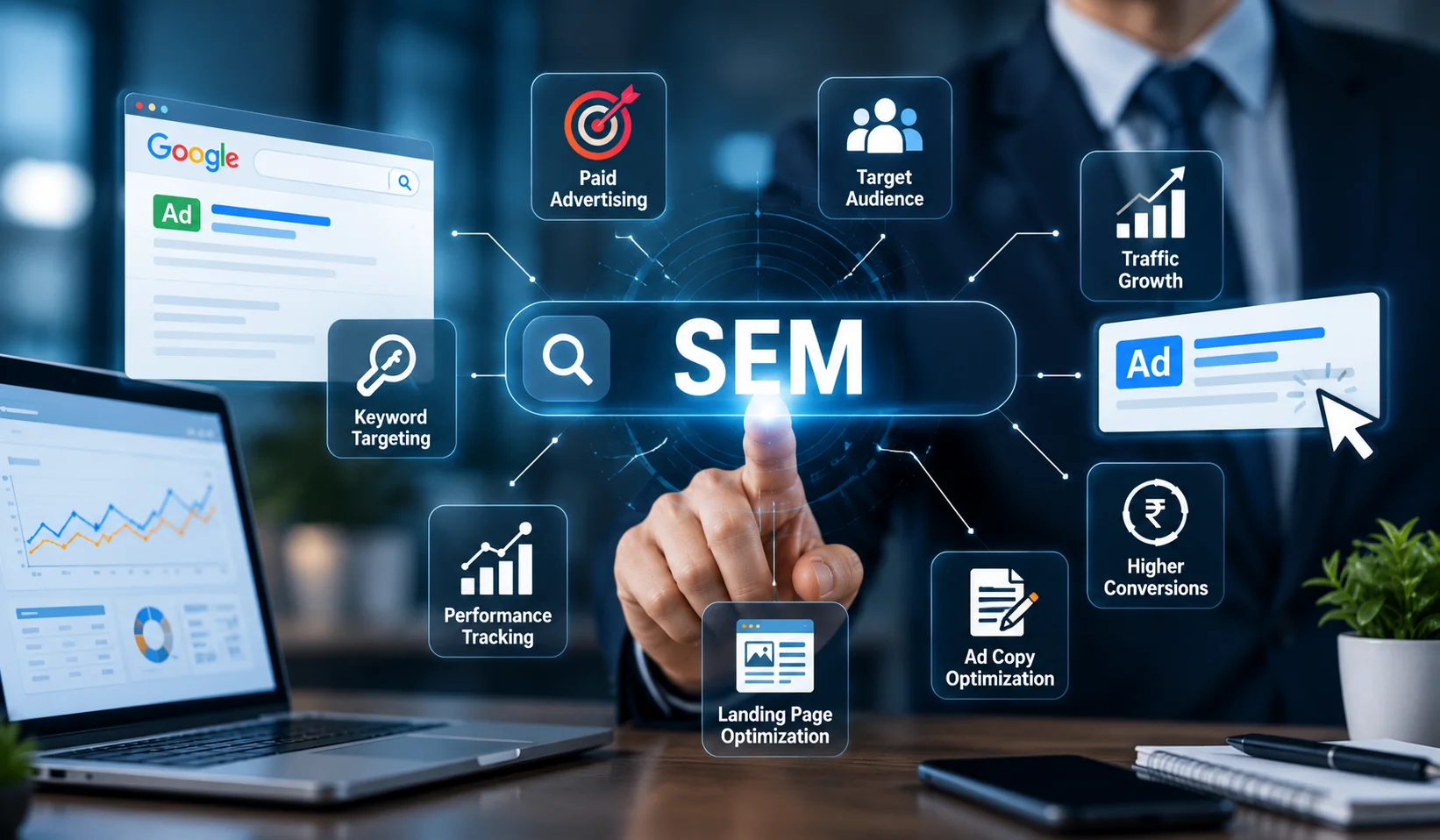
Search engine marketing (SEM) is a digital marketing strategy that helps businesses increase their visibility on search engine results pages (SERPs) through paid advertising and search-focused optimization techniques. It allows brands to reach users actively searching for products, services, or information by targeting relevant keywords and search intent.
What Is Search Engine Marketing (SEM)?
Search engine marketing is the practice of promoting websites, products, or services through search engines to attract targeted visitors. It combines paid search advertising and search visibility strategies to help businesses appear when potential customers search for relevant terms.
In simple terms, SEM helps businesses connect with people at the exact moment they are looking for a solution. Instead of relying only on users discovering a brand through traditional marketing channels, search engine marketing places businesses in front of audiences with existing interest or purchase intent.
For example, when a user searches for “best digital marketing agency in India” on a search engine, businesses can use SEM strategies to appear prominently in the search results. This visibility can come through paid advertisements, commonly known as pay-per-click (PPC) campaigns, where advertisers pay when users click on their ads.
How Search Engine Marketing Works
Search engine marketing (SEM) works by displaying targeted advertisements on search engine results pages when users search for specific keywords related to products, services, or information. Businesses create campaigns, select relevant keywords, bid for ad placements, and optimize performance based on clicks, conversions, and user behaviour.
The Step-by-Step Process of Search Engine Marketing
Search engine marketing follows a structured process that connects businesses with users actively searching for relevant solutions. The process involves keyword research, campaign creation, search advertising, bidding, ad placement, and continuous optimization.
Step 1: Identify Target Audience and Search Intent
The first step in SEM is understanding who the business wants to reach and what users are searching for.
Marketers analyze:
-
Customer needs
-
Search behaviour
-
Buying intent
-
Common questions
-
Problems users want to solve
For example, a user searching for “best accounting software for small businesses” has a stronger commercial intent than someone searching “what is accounting software.”
Understanding search intent helps businesses create campaigns that match user expectations and deliver relevant messages.
Step 2: Conduct Keyword Research
Keywords are the foundation of search engine marketing. They are the terms and phrases users enter into search engines when looking for information, products, or services.
During keyword research, marketers identify:
-
High-value search terms
-
Commercial keywords
-
Long-tail keywords
-
Competitor keywords
-
Search volume and competition levels
For example:
|
Keyword Type |
Example |
User Intent |
|
Informational keyword |
What is digital marketing? |
Learning |
|
Commercial keyword |
Best SEO agency in India |
Comparing options |
|
Transactional keyword |
Hire SEO services |
Ready to purchase |
Selecting the right keywords helps businesses show advertisements to users who are more likely to engage or convert.
Step 3: Create Search Advertising Campaigns
After selecting keywords, businesses create search advertising campaigns through advertising platforms such as Google Ads.
A typical search advertising campaign includes:
-
Campaign goals
-
Target keywords
-
Ad copy
-
Landing pages
-
Budget settings
-
Audience targeting options
The advertisement usually appears above or below organic search results when a user's search query matches the selected keywords.
A well-designed search ad should:
-
Address user needs
-
Include relevant keywords
-
Provide a clear benefit
-
Encourage users to take action
Step 4: Participate in the PPC Auction
Most search engine marketing campaigns operate through a pay-per-click (PPC) model.
In PPC advertising, businesses do not usually pay simply because their advertisement appears. Instead, they pay when a user clicks on the advertisement.
When someone searches for a keyword, search engines conduct an automated auction to decide:
-
Which advertisements appear
-
Their position on the search results page
-
The cost per click
The auction considers multiple factors, including:
-
Bid amount
-
Advertisement relevance
-
Landing page quality
-
Expected user experience
A higher budget alone does not guarantee the top position. Search engines also evaluate the usefulness and relevance of advertisements.
Step 5: Display Ads on Search Results Pages
After the auction process, selected advertisements appear on search results pages.
Users may see:
-
Paid search advertisements
-
Shopping advertisements
-
Local search advertisements
-
Organic search results
SEM helps businesses appear in front of users at important moments, such as when they are researching products, comparing services, or preparing to make a purchase.
For example:
A person searches:
“best laptop for graphic designers”
A technology company running SEM campaigns can display an advertisement promoting relevant laptops or offers.
Step 6: Send Users to Optimized Landing Pages
Clicking a search advertisement is only one part of SEM success. The destination page, known as a landing page, plays an important role in converting visitors.
An effective landing page should include:
-
Clear information matching the advertisement
-
Fast loading speed
-
Strong value proposition
-
Easy navigation
-
Clear call-to-action
For example, if an advertisement promotes “SEO services for startups,” the landing page should explain startup-focused SEO solutions rather than directing users to a general homepage.
Step 7: Measure Campaign Performance
One of the biggest advantages of SEM is the ability to track measurable results.
Businesses monitor metrics such as:
|
Metric |
Meaning |
|
Impressions |
Number of times an advertisement appears |
|
Clicks |
Number of users who visit the website |
|
Click-through rate (CTR) |
Percentage of users who click the advertisement |
|
Cost per click (CPC) |
Amount paid for each click |
|
Conversion rate |
Percentage of visitors completing an action |
|
Return on ad spend (ROAS) |
Revenue generated compared with advertising cost |
These measurements help marketers understand campaign performance and identify improvement opportunities.
Step 8: Optimize and Improve Campaign Results
SEM is not a one-time activity. Successful campaigns require continuous testing and optimization.
Marketers improve campaigns by:
-
Removing low-performing keywords
-
Testing different advertisements
-
Adjusting bids
-
Improving landing pages
-
Refining audience targeting
-
Analyzing search trends
Continuous optimization helps businesses improve efficiency and make better use of their advertising budgets.
Understanding Search Engines in Digital Marketing
Search engines are online platforms that help users find information, products, services, and answers by entering search queries. In digital marketing, search engines act as a connection point between businesses and potential customers.
Platforms such as Google, Bing, and other search engines analyze user queries and display relevant results based on factors such as keywords, content quality, relevance, user experience, and advertising campaigns.
For businesses, search engines provide an opportunity to:
-
Reach users with specific needs and interests
-
Increase website visibility
-
Generate qualified traffic
-
Promote products and services
-
Understand customer search behaviour
Search engine marketing uses this search behaviour to create targeted campaigns that align business offerings with user intent.
Why Is Search Engine Marketing Important?
Search engine marketing is important because modern consumers often begin their buying journey through search engines. Whether users are researching a product, comparing services, or looking for immediate solutions, search engines influence many online decisions.
Unlike broad advertising methods that target large audiences, SEM focuses on reaching users based on their search intent. This allows businesses to show relevant messages to people who are already interested in specific topics, products, or services.
1. Reaches High-Intent Audiences
Search engine marketing allows businesses to connect with users who are actively searching for solutions. A person searching for “buy running shoes online” has a different level of intent compared with someone who only views a general advertisement.
SEM helps businesses target these high-intent searches and increase the chances of meaningful interactions.
2. Provides Faster Search Visibility
Organic search growth through SEO often requires consistent effort and time. SEM can provide immediate visibility by allowing businesses to display advertisements on search engine results pages after setting up campaigns.
This makes SEM useful for new businesses, product launches, seasonal campaigns, and competitive markets.
3. Offers Measurable Marketing Performance
One major advantage of search engine marketing is its ability to track performance. Businesses can measure metrics such as:
-
Clicks
-
Impressions
-
Conversion rates
-
Cost per click (CPC)
-
Return on advertising spend (ROAS)
These insights help marketers understand campaign effectiveness and optimize future strategies.
4. Supports Business Growth Through Targeted Advertising
SEM enables businesses to target specific audiences using factors such as:
-
Keywords
-
Location
-
Device type
-
Search behaviour
-
Audience characteristics
This level of targeting helps companies use their marketing budgets more efficiently compared with traditional advertising methods.
Search Engine Marketing vs Traditional Digital Marketing
Traditional digital marketing methods often rely on reaching users through broad channels such as display advertising, social media campaigns, or email marketing. While these methods can build awareness, they may not always capture immediate user demand.
Search engine marketing focuses on capturing existing demand. When users search for information, products, or services, SEM helps businesses appear during that decision-making process.
For example:
|
Marketing Approach |
User Stage |
Example |
|
Social media advertising |
Awareness stage |
User sees a brand promotion |
|
Display advertising |
Interest stage |
User views product-related ads |
|
Search engine marketing |
Active search stage |
User searches for a product and sees relevant ads |
The Role of Search Engine Marketing in Modern Digital Marketing
Search engine marketing plays an important role in helping businesses improve online visibility, attract targeted visitors, and compete in digital markets. It works alongside other digital marketing activities, especially search engine optimization (SEO), content marketing, and conversion optimization.
While SEO focuses on earning organic visibility through valuable content and website improvements, SEM provides paid opportunities to appear in search results immediately. Many businesses combine both approaches to create a balanced search marketing strategy.
A strong digital marketing plan often uses:
-
SEO for long-term organic growth
-
SEM for immediate visibility and targeted campaigns
-
Content marketing for education and trust building
-
Analytics for performance measurement
By understanding how search engines work and how users search online, businesses can create more effective marketing campaigns that match customer needs.
The Search Engine Business Model: How Search Engines Make Money
The search engine business model is primarily based on connecting users, advertisers, and businesses through search technology. Search engines generate revenue mainly through advertising, where businesses pay to display targeted ads based on user searches, keywords, and purchase intent. This creates a cycle where users receive relevant results, while businesses gain visibility and customers.
Understanding the Search Engine Business Model
Search engines operate as platforms that organize and provide access to massive amounts of online information. While many search engines offer free access to users, they generate significant revenue by monetizing user search activity through advertising and related services.
1. Revenue Source: How Search Engines Generate Income
The primary revenue source for major search engines is digital advertising. Search engines collect revenue by allowing businesses to promote their products and services when users search for relevant terms.
Unlike traditional advertising models that target broad audiences, search engine advertising focuses on user intent. Businesses are willing to invest because search queries often indicate a specific need, problem, or buying interest.
Common revenue sources include:
Search Advertising
Search advertising is the biggest contributor to the search engine business model. Businesses pay to display advertisements on search engine results pages (SERPs).
For example:
A user searches:
“best web hosting provider”
Companies offering web hosting services can bid on this keyword to show their advertisements to users actively researching hosting solutions.
Pay-Per-Click (PPC) Advertising
Many search engines use a PPC model, where advertisers pay only when users click on their advertisements.
The PPC model benefits both sides:
-
Businesses pay for actual user engagement
-
Search engines generate revenue from advertiser competition
-
Users see advertisements related to their searches
The value of a click depends on factors such as:
-
Keyword competition
-
Industry demand
-
User purchase intent
-
Advertisement relevance
Shopping and Product Advertising
Search engines also generate revenue through product-focused advertisements.
Businesses can promote:
-
Products
-
Prices
-
Offers
-
Store information
These advertisements help users compare options while allowing businesses to reach customers closer to the purchasing stage.
2. Advertising: Turning Search Results Into Business Opportunities
Advertising is the connection point between search engines and businesses. Search engines provide advertising platforms where companies can compete for visibility based on specific keywords.
The process usually works like this:
Business selects keywords → Creates an advertisement → Bids for placement → Search engine evaluates relevance → Advertisement appears
Search engines consider several factors when displaying advertisements, including:
-
Bid amount
-
Advertisement quality
-
Keyword relevance
-
Landing page experience
-
Expected user response
This approach allows search engines to maintain useful results while generating advertising revenue.
3. User Intent: The Foundation of Search Engine Revenue
User intent is one of the most valuable parts of the search engine business model.
Every search query provides information about what a user wants to accomplish. This could include:
-
Finding information
-
Comparing products
-
Locating services
-
Making a purchase
-
Solving a problem
For example:
|
Search Query |
User Intent |
Business Opportunity |
|
How does SEO work? |
Informational |
SEO tools, courses, educational content |
|
Best smartphones under ₹30,000 |
Commercial |
Electronics brands and retailers |
|
Buy running shoes online |
Transactional |
E-commerce businesses |
Search engines use this intent data to display more relevant advertisements and search results.
The stronger the user intent, the more valuable the search becomes for advertisers.
4. Businesses: Why Companies Invest in Search Engines
Businesses use search engines because they provide access to audiences already showing interest in specific products, services, or information.
Compared with traditional advertising, search engine marketing allows businesses to target users based on active demand rather than general audience characteristics.
Businesses benefit from search advertising through:
Targeted Visibility
Companies can appear when users search for specific keywords related to their offerings.
Measurable Results
Businesses can track:
-
Website visits
-
Leads
-
Sales
-
Advertising costs
-
Customer acquisition data
Better Budget Control
Advertisers can control:
-
Daily budgets
-
Keyword targeting
-
Geographic locations
-
Audience segments
This makes search advertising suitable for businesses of different sizes, from small businesses to large enterprises.
Search Engines Ratio: Understanding Market Distribution
The search engines ratio refers to the market share distribution among different search platforms. Search engine usage varies by country, device type, and user preferences.
Globally, a small number of search engines account for the majority of online searches, while several smaller platforms serve specific audiences.
A general comparison of major search engines:
|
Search Engine |
Market Position |
Key Strength |
Business Opportunity |
|
Google Search |
Largest global search platform |
Advanced algorithms, large user base, advertising ecosystem |
SEO, SEM, PPC advertising |
|
Microsoft Bing |
Major alternative search engine |
Integration with Microsoft products and AI features |
Search advertising and enterprise reach |
|
Yahoo Search |
Established search platform |
Long-standing user base in selected markets |
Additional search visibility |
|
DuckDuckGo |
Privacy-focused search engine |
User privacy approach |
Privacy-conscious audiences |
|
Regional Search Platforms |
Market-specific platforms |
Local user behaviour and preferences |
Regional targeting opportunities |
Advantages of Search Engine Marketing
Search engine marketing provides businesses with targeted visibility by helping them reach users who are actively searching for relevant products, services, or information. Its major advantages include faster search visibility, measurable performance tracking, budget flexibility, precise audience targeting, and access to high purchase-intent traffic.
Benefits of Search Engine Marketing
Search engine marketing (SEM) has become an important digital marketing strategy because it allows businesses to connect with potential customers at the exact moment they are searching for solutions. Unlike many traditional marketing methods that focus on broad awareness, SEM focuses on capturing existing user demand through targeted search advertising.
The following are the key advantages of search engine marketing:
1. Targeted Audience Reach
One of the biggest advantages of SEM is the ability to reach highly specific audiences based on their search behaviour and interests.
Search engine marketing allows businesses to target users through:
-
Specific keywords
-
Geographic locations
-
Languages
-
Devices
-
Audience characteristics
-
Search intent
For example, a local dental clinic can create search advertising campaigns targeting users searching for “dentist near me” within a specific city. This ensures that advertisements appear to people who are more likely to need the service.
Unlike traditional advertising, where businesses often reach a large audience with varying levels of interest, SEM focuses on users who have already shown interest through their searches.
2. Faster Visibility in Search Results
Achieving strong organic rankings through SEO can take time, especially for new websites or highly competitive industries. Search engine marketing provides businesses with a way to gain immediate visibility on search engine results pages (SERPs).
Through paid search advertising, businesses can appear in prominent positions when users search for relevant keywords.
For example:
A new e-commerce brand launching a product can use SEM campaigns to appear for product-related searches while building long-term organic visibility through SEO.
Faster visibility makes SEM useful for:
-
New businesses
-
Product launches
-
Seasonal promotions
-
Limited-time offers
-
Competitive markets
3. Measurable Performance and Data Insights
A major benefit of search engine marketing is the ability to measure campaign performance accurately.
Businesses can track important metrics such as:
|
Performance Metric |
Purpose |
|
Impressions |
Measures how often advertisements appear |
|
Clicks |
Shows user engagement with ads |
|
Click-through rate (CTR) |
Measures advertisement effectiveness |
|
Conversion rate |
Tracks completed actions such as purchases or enquiries |
|
Cost per click (CPC) |
Measures advertising cost efficiency |
|
Return on ad spend (ROAS) |
Evaluates revenue generated from campaigns |
These insights help marketers understand what works, identify areas for improvement, and optimize campaigns based on real user behaviour.
4. Better Budget Control
Search engine marketing provides businesses with flexibility in managing advertising budgets. Unlike traditional advertising methods that may require large upfront investments, SEM allows advertisers to control spending based on their goals.
Businesses can adjust:
-
Daily advertising budgets
-
Keyword bids
-
Campaign duration
-
Target locations
-
Audience segments
For example, a small business can start with a limited SEM budget, analyze results, and gradually increase investment in campaigns that generate better outcomes.
This level of control makes SEM accessible for businesses of different sizes.
5. Access to High Purchase-Intent Traffic
Search engine marketing helps businesses reach users who are already looking for specific solutions.
Search queries often reveal a user's stage in the buying journey. Someone searching for a general topic may still be researching, while someone searching for a product, service, or pricing information may be closer to making a decision.
Examples:
|
Search Query |
Intent Level |
|
What is cloud software? |
Informational |
|
Best cloud software for businesses |
Commercial research |
|
Buy cloud software subscription |
Transactional |
SEM allows businesses to appear during these high-intent searches, increasing the opportunity to attract qualified visitors.
6. Improves Brand Visibility and Awareness
Even when users do not immediately click an advertisement, appearing frequently in search results can improve brand recognition.
Consistent visibility helps businesses:
-
Build familiarity
-
Increase trust
-
Stay competitive in crowded markets
When users repeatedly see a brand while searching for related topics, they may become more likely to consider that brand during future purchasing decisions.
7. Supports Local Business Growth
Search engine marketing is particularly valuable for businesses targeting local customers.
Local SEM campaigns can help businesses promote:
-
Nearby services
-
Store locations
-
Appointment-based businesses
-
Regional offers
For example, a user searching “emergency plumber in Mumbai” is likely looking for an immediate solution. A local business using SEM can appear at that critical moment.
Disadvantages and Limitations of Search Engine Marketing
While search engine marketing (SEM) helps businesses gain targeted visibility and reach potential customers quickly, it also has limitations. Common challenges include ongoing advertising costs, high competition, dependence on paid traffic, and the need for continuous campaign optimization. Understanding these search engine pros and cons helps businesses create more effective marketing strategies.
Understanding the Limitations of Search Engine Marketing
Search engine marketing can be a powerful digital marketing channel, but it is not a guaranteed solution for every business. Unlike organic strategies that can generate long-term visibility, SEM requires continuous investment and management to maintain results.
Businesses should evaluate both the benefits and limitations of SEM before allocating their marketing budgets.
Search Engine Pros and Cons: Advantages vs Limitations
|
Advantages of SEM |
Limitations of SEM |
|
Provides immediate visibility on search engine results pages |
Requires continuous advertising investment to maintain traffic |
|
Reaches users with specific search intent |
Competitive keywords can become expensive |
|
Allows precise audience targeting |
Poor campaign management can lead to wasted budget |
|
Provides measurable performance data |
Requires ongoing monitoring and optimization |
|
Offers flexible budget control |
Results may decrease when advertising stops |
|
Helps businesses test keywords and customer demand |
Users may prefer organic results over advertisements |
|
Supports quick promotion of products and services |
Requires expertise in keyword selection and campaign management |
Key Disadvantages of Search Engine Marketing
1. Continuous Advertising Costs
One of the biggest limitations of SEM is that businesses must continue investing in advertising to maintain visibility.
Unlike SEO, where optimized content can continue attracting organic traffic over time, paid search advertisements usually stop generating traffic when the campaign budget ends.
For example:
A business running a PPC campaign may receive visitors while advertisements are active. However, if the company pauses the campaign, its paid visibility can immediately decrease.
This makes SEM an ongoing marketing expense rather than a one-time investment.
2. High Competition for Popular Keywords
Competitive industries often have many businesses targeting the same keywords. This competition can increase advertising costs and make it more challenging for smaller businesses to compete.
High-cost keywords commonly appear in industries such as:
-
Finance
-
Insurance
-
Real estate
-
Healthcare
-
Legal services
Businesses may need advanced keyword strategies and optimized campaigns to achieve profitable results in competitive markets.
3. Risk of Budget Wastage
SEM campaigns require careful planning and monitoring. Without proper optimization, businesses may spend money on clicks that do not generate valuable outcomes.
Common causes of wasted advertising budgets include:
-
Targeting irrelevant keywords
-
Poor-quality advertisements
-
Incorrect audience targeting
-
Weak landing pages
-
Lack of conversion tracking
Effective SEM requires continuous analysis to ensure advertising spend generates meaningful results.
4. Requires Continuous Management and Optimization
Search engine marketing is not a set-and-forget strategy. Search trends, competition, and user behaviour constantly change.
Businesses need to regularly review:
-
Keyword performance
-
Advertisement quality
-
Conversion rates
-
Bid strategies
-
Customer behaviour
Without ongoing optimization, campaign performance may decline over time.
5. Results May Stop When Advertising Stops
A major difference between SEM and SEO is the relationship between investment and visibility.
With SEM:
Advertising budget active → Ads appear → Traffic generated
When campaigns stop:
Advertising budget stops → Paid visibility decreases → Traffic may decline
This dependency means businesses need a consistent budget strategy to maintain paid search performance.
6. Requires Technical Knowledge and Expertise
Creating effective SEM campaigns involves more than simply creating advertisements.
Successful campaigns require knowledge of:
-
Keyword research
-
Search intent analysis
-
PPC bidding strategies
-
Advertisement copywriting
-
Landing page optimization
-
Analytics interpretation
Businesses without internal expertise may need professional support to manage campaigns effectively.
7. Advertisement Blindness Among Users
Some users prefer organic search results and may ignore paid advertisements.
Factors influencing this behaviour include:
-
Trust in organic results
-
Previous experiences with advertisements
-
Preference for unbiased information
Because of this, businesses often combine SEM with SEO to capture both paid and organic search opportunities.
Is Search Engine Marketing Still Important in 2026?
Yes, search engine marketing remains an important digital marketing strategy in 2026 because users continue to rely on search platforms to discover information, products, and services. However, the way businesses approach SEM is changing due to AI-powered search experiences, evolving user behaviour, and the need to combine paid advertising with strong organic visibility.
The Changing Role of Search Engine Marketing in 2026
Search engine marketing has evolved from simply placing advertisements on search results pages into a broader strategy focused on understanding user intent, delivering relevant information, and creating meaningful customer journeys.
While search engines are changing with artificial intelligence and new discovery methods, the fundamental purpose of SEM remains the same:
Connecting businesses with users who are actively searching for solutions.
Businesses still depend on search visibility because search behaviour often reflects strong intent. Users continue to search for products, compare services, research problems, and make purchasing decisions through search platforms.
However, successful SEM strategies in 2026 require businesses to adapt to new search environments.
1. AI Search Is Changing How Users Find Information
Artificial intelligence is transforming the search experience. Modern search platforms are increasingly using AI to understand complex queries, summarize information, and provide more conversational answers.
This shift affects how businesses approach search marketing.
Previously, users often:
Search query → Click website → Find information
The evolving experience may become:
Search query → AI-generated answer → User explores recommended sources → Business interaction
This means businesses need to focus beyond traditional keyword targeting and create content that demonstrates:
-
Expertise
-
Accuracy
-
Clear answers
-
Strong topical relevance
-
Reliable information
SEM strategies must adapt by understanding how AI systems interpret content and user intent.
2. Search Behaviour Is Becoming More Intent-Focused
User search behaviour continues to become more specific. People are no longer searching only with short keywords; they are increasingly using detailed queries that reflect their exact needs.
Examples:
Broad search:
“CRM software”
More specific search:
“Best CRM software for small businesses with email automation”
The second search provides stronger insight into user intent.
In 2026, businesses need to focus on:
-
Search intent analysis
-
Long-tail keywords
-
Audience problems
-
Customer journey stages
-
Helpful landing pages
Successful SEM campaigns will not only target keywords but also understand why users are searching.
3. Paid and Organic Search Strategies Need to Work Together
The future of search marketing is not about choosing between SEO and SEM. Businesses increasingly benefit from combining both approaches.
SEO and SEM serve different purposes:
|
SEO |
SEM |
|
Builds organic visibility |
Provides paid visibility |
|
Supports long-term growth |
Supports immediate traffic |
|
Builds authority and trust |
Targets specific search opportunities |
|
Requires content and optimization |
Requires advertising investment |
A balanced search strategy allows businesses to:
-
Capture immediate demand through SEM
-
Build sustainable visibility through SEO
-
Test keywords through paid campaigns
-
Improve organic content using search data
For example, a keyword that performs well in a PPC campaign may indicate an opportunity to create SEO-focused content around that topic.
4. Businesses Still Need SEM for Competitive Visibility
As more businesses compete online, gaining visibility in search results becomes increasingly challenging.
SEM remains valuable because it helps businesses:
-
Reach customers faster
-
Promote important products or services
-
Compete in crowded markets
-
Test customer demand
-
Generate measurable results
However, successful SEM in 2026 will depend less on simply increasing advertising budgets and more on improving relevance, user experience, and campaign strategy.
How Businesses Can Build an Effective Search Engine Marketing Strategy
An effective search engine marketing strategy follows a structured process: research, planning, execution, measurement, and optimization. Businesses need to understand their audience, select the right keywords, create relevant campaigns, track performance, and continuously improve results based on data.
1. Research: Understand Audience, Market, and Keywords
The first step is researching what users are searching for and how those searches connect with business goals.
Research includes:
Audience Research
Understand:
-
Customer needs
-
Problems they want to solve
-
Buying behaviour
-
Decision-making process
Keyword Research
Identify:
-
Relevant search terms
-
Commercial keywords
-
Long-tail keywords
-
Competitor keywords
-
Search intent
Competitor Analysis
Study:
-
Competitor advertisements
-
Keyword targeting
-
Landing pages
-
Offers and messaging
Effective research ensures SEM campaigns target valuable opportunities instead of wasting budget on irrelevant searches.
2. Planning: Create the SEM Campaign Structure
After research, businesses need a clear campaign plan.
Planning involves:
Defining Campaign Goals
Examples:
-
Generate leads
-
Increase product sales
-
Promote services
-
Build brand awareness
-
Drive website traffic
Selecting Target Keywords
Keywords should match:
-
Business objectives
-
User intent
-
Customer journey stage
Setting Budget and Bidding Strategy
Businesses should determine:
-
Daily spending limits
-
Target cost per acquisition
-
Expected campaign outcomes
Creating Landing Page Strategy
Each advertisement should direct users to a page that matches their search intent.
For example:
Advertisement:
“Affordable SEO services for startups”
Landing page:
“SEO solutions designed specifically for startup businesses”
3. Execution: Launch and Manage Campaigns
During execution, businesses create and publish search advertising campaigns.
Key activities include:
-
Writing advertisement copy
-
Adding targeted keywords
-
Setting audience preferences
-
Creating landing pages
-
Launching campaigns
Effective advertisements should:
-
Match user searches
-
Highlight benefits
-
Include clear calls-to-action
-
Provide relevant solutions
4. Measurement: Track Campaign Performance
Measurement helps businesses understand whether SEM campaigns are achieving their goals.
Important metrics include:
|
Metric |
Purpose |
|
Impressions |
Measures advertisement visibility |
|
Click-through rate (CTR) |
Shows user engagement |
|
Cost per click (CPC) |
Measures advertising cost |
|
Conversion rate |
Tracks successful actions |
|
Cost per acquisition (CPA) |
Measures customer acquisition efficiency |
|
Return on ad spend (ROAS) |
Evaluates financial performance |
Tracking these metrics allows businesses to make decisions based on actual performance rather than assumptions.
5. Optimization: Improve Campaign Results
Optimization is the ongoing process of improving SEM performance.
Businesses can optimize campaigns by:
-
Removing ineffective keywords
-
Improving advertisement messaging
-
Testing different headlines
-
Adjusting bids
-
Improving landing pages
-
Refining audience targeting
Continuous optimization helps businesses improve campaign efficiency and achieve better outcomes over time.


Leave a Comment
Your email address will not be published. Required fields are marked *