

- August 25, 2026
Table of Contents
What Is Page Authority in SEO?
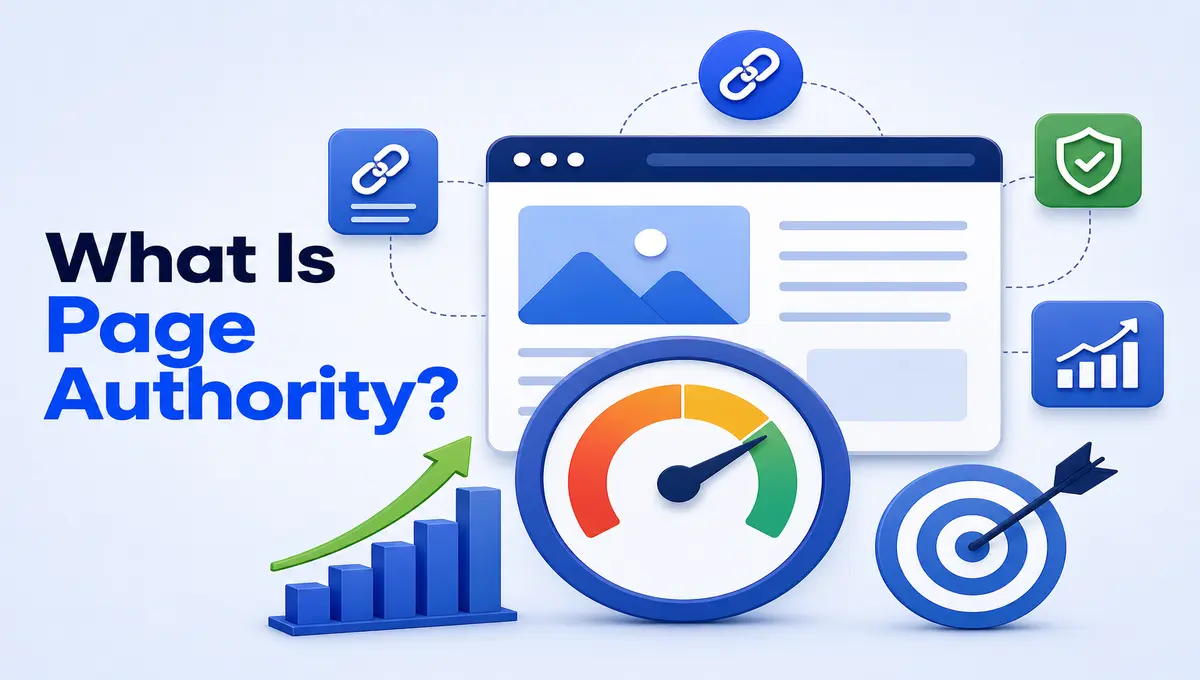
Page Authority (PA) is a metric developed by Moz that predicts how likely a specific webpage is to rank in search engine results. It scores individual URLs on a logarithmic scale from 1 to 100. A higher score indicates stronger relative ranking potential, but it does not guarantee higher rankings.
Unlike Domain Authority, which evaluates an entire domain or subdomain, Page Authority focuses on one page. Every URL on a website can therefore have a different PA score depending largely on its link profile and the signals captured by Moz’s index.
SEO professionals commonly use Page Authority to:
- Compare pages competing for the same keyword
- Assess the relative strength of individual URLs
- Identify pages that may need stronger internal links or backlinks
- Evaluate potential link-building opportunities
- Monitor changes in page-level authority over time
Page Authority is a comparative SEO metric, not a Google ranking factor. Google does not use Moz’s PA score in its ranking systems. A high-PA page may still rank poorly if its content does not satisfy search intent, while a lower-PA page may perform better because it is more relevant and useful.
A Simple Page Authority Example
Suppose an Indian digital-marketing website has two pages:
- A detailed SEO guide with links from industry publications has a PA of 42.
- A recently published service page with few internal links and no external backlinks has a PA of 18.
The first page has a stronger page-level link profile, so Moz may assign it a higher PA. However, these scores should not be compared in isolation. The service page’s PA should be benchmarked against other pages ranking for the same service-related keyword.
This demonstrates an important principle: a website can have strong overall authority while individual pages have very different PA scores. Page Authority is most useful when similar pages, keywords, and competitors are compared under the same conditions.
How Does Moz Calculate Page Authority?
Moz calculates Page Authority using link data from its Link Explorer web index and a machine-learning model. The complete formula is proprietary, so outside sources cannot reliably provide an exact list or weighting of every factor.
The calculation can be understood through this simplified process:
- Moz crawls and indexes webpages: Link Explorer collects information about pages and how they link to one another.
- Link relationships are evaluated: Moz examines the link profile associated with an individual URL using signals available within its index.
- A machine-learning model processes the data: The model identifies patterns associated with pages that perform competitively in search results.
- Moz generates a predictive score: The page receives a PA score between 1 and 100, representing its relative ranking potential.
- The score is recalculated as data changes: New links, lost links, and updates to Moz’s index or model can alter the result.
Page Authority should therefore be treated as a comparative estimate—not an exact measurement of how Google evaluates a page. Moz does not publish every calculation factor, and its link index is separate from Google’s index.
Why PA Uses a Logarithmic Scale
Page Authority uses a logarithmic scale, which means improvement becomes progressively harder at higher levels. Increasing a page’s score from 20 to 30 is generally easier than moving it from 70 to 80.
This happens because pages at the upper end compete with URLs possessing exceptionally strong link profiles. Each additional increase may require substantially stronger signals than an equivalent numerical increase at the lower end.
For this reason, marketers should avoid setting arbitrary PA targets. A more useful approach is to compare a page with relevant competitors targeting the same search query.
What Is a Good Page Authority Score?
A good Page Authority score is one that is competitive with the pages currently ranking for your target keyword. There is no universal PA number that guarantees strong organic performance. A score of 25 may be sufficient in a low-competition niche, while 50 may be inadequate for a highly competitive query.
The correct approach is to compare your page with relevant competing URLs using the same Moz tool and measurement period. PA should be considered alongside content relevance, backlinks, referring domains, search intent, and current rankings.
Why There Is No Universal Good PA Score
Moz Page Authority is a comparative metric, not an absolute quality grade. Its meaning changes according to:
- Search query: Every keyword has a different competitive landscape.
- Industry: Finance and technology pages may compete against stronger link profiles than local service pages.
- Location: Local Indian searches may have different competitors from national or international queries.
- Page type: Compare service pages with service pages and informational articles with similar articles.
- Competitor strength: A PA score only becomes meaningful when viewed against URLs competing for the same search visibility.
Generic ranges such as “1–20 is poor” or “40–60 is good” can be misleading. They ignore whether the page can compete in its actual SERP.
How to Benchmark Your PA Against Competitors
Use this seven-step Page Authority worksheet:
- Select one target keyword assigned to the page.
- Record your page’s PA using Moz Link Explorer or MozBar.
- Identify the leading organic results for the keyword, excluding advertisements and irrelevant listings.
- Record each competitor URL’s PA using the same Moz tool on the same date.
- Calculate the median competitor PA to prevent one unusually strong result from distorting the benchmark.
- Compare supporting factors, including referring domains, relevant backlinks, content dept,h and internal links.
- Track the results monthly, recording PA, rankings, organic traffic and conversions separately.
This process shows whether authority may be a competitive weakness without assuming that PA alone determines rankings.
Example PA Comparison
Suppose a Jaipur-based company targets “office interior designers in Jaipur.”
Page | PA | Referring domains | Position |
Competitor A | 34 | 28 | 1 |
Competitor B | 29 | 19 | 2 |
Competitor C | 31 | 22 | 3 |
Your service page | 24 | 9 | 8 |
The median competitor PA is 31, placing the target page seven points below the benchmark. This suggests a possible page-level authority gap, supported by its lower number of referring domains.
However, the business should not pursue PA alone. It should also improve service relevance, local proof, internal links and page quality while earning legitimate links to the specific URL. The objective is stronger organic performance—not merely a higher Moz score.
Page Authority vs Domain Authority vs PageRank
Page Authority, Domain Authority, and PageRank all relate to webpage strength, but they are not interchangeable. PA and DA are third-party metrics developed by Moz, whereas PageRank is part of Google’s ranking systems.
Metric | Owner | Scope | Main use |
Page Authority (PA) | Moz | Individual URL | Compare page-level ranking potential |
Domain Authority (DA) | Moz | Domain or subdomain | Compare domain-level strength |
PageRank | Pages and link relationships | Component of Google’s ranking systems |
Page Authority and Domain Authority are SEO metrics developed by Moz. Google does not use these scores as ranking factors. Instead, Google relies on its own ranking systems, including PageRank and many other signals, to evaluate webpages.
Page Authority vs Domain Authority
Page Authority estimates the relative ranking potential of one URL. Domain Authority predicts the comparative ranking strength of an entire domain or subdomain. Both use a 1–100 logarithmic scale.
A high-DA website can contain low-PA pages because domain-level strength is not distributed equally across every URL. For example, a reputable news website may have a high DA, but a newly published article could initially have a much lower PA because it has few internal or external links.
Use PA when comparing specific pages competing for the same keyword. Use DA when evaluating the broader strength of websites, such as during competitor research or link prospecting. Neither metric should be used alone to judge content quality or predict rankings. Google does not use Moz’s Page Authority score as a direct ranking factor.
Page Authority vs Google PageRank
Moz Page Authority is a third-party prediction designed for SEO comparison. PageRank is Google’s system for understanding links between pages and assessing which pages may be useful or important. Google does not use Moz’s Page Authority score as a direct ranking factor.
Google has confirmed that PageRank is still part of its ranking systems, but it works alongside many other ranking signals. It is not the only factor that determines search rankings.
Therefore, a PA score should not be interpreted as a public substitute for Google PageRank. Moz PA reflects Moz’s data and methodology; PageRank operates within Google’s private ranking infrastructure. A page can have a strong PA and still fail to rank if its content is irrelevant, inaccessible,e or poorly aligned with search intent.
Why Does Page Authority Matter for SEO?
Page Authority matters because it provides a consistent way to compare the relative strength of individual webpages. It can help SEO professionals make better decisions about competitor analysis, backlinks, link prospecting, and internal linking.
PA does not measure content quality or guarantee rankings. Its practical value lies in the following use cases:
- Comparing pages targeting one keyword: Check the PA of your URL and the pages ranking for the same query. A substantial difference may reveal a page-level authority gap, although content relevance, search intent and technical performance must also be reviewed.
- Prioritizing link-building targets: Identify commercially important pages with weaker PA and fewer relevant referring domains than their competitors. These URLs may deserve focused outreach, digital PR, or linkable supporting content.
- Reviewing link-placement opportunities: PA can help assess the relative strength of the specific page offering a backlink. This is more precise than checking only the website’s Domain Authority, because a strong domain can still contain weak or newly published pages.
- Identifying internal-link sources: Pages with strong PA, relevant content, and valuable external links may be suitable sources for contextual internal links. Linking from these pages can help users discover related content and distribute link equity across the website.
- Monitoring page-level authority trends: Tracking PA over time may help reveal the effect of new backlinks, lost links, or changes within Moz’s link index. Monthly monitoring is generally more useful than checking the score daily.
Page Authority is most useful when it supports a broader SEO assessment. Record it alongside keyword rankings, organic traffic, referring domains, conversions,s and content performance. If PA increases but visibility and qualified traffic remain unchanged, the score alone should not be treated as evidence of SEO success.
How to Check Page Authority
The most reliable way to check Page Authority is through Moz, the company that created the metric. Moz Link Explorer provides URL-level link data, while MozBar displays authority metrics as you browse webpages and search results.
Use the same tool for all comparisons because third-party PA checkers may use different data, update schedules, or calculation methods.
Check PA With Moz Link Explorer
Follow this process to check an individual URL:
- Open Moz Link Explorer.
- Enter the complete URL, including https://.
- Select the option to analyse the exact page rather than only the root domain.
- Run the analysis.
- Locate the Page Authority score in the URL-level results.
- Review the page’s inbound links and linking domains.
- Repeat the process for relevant competing pages.
Always compare equivalent page types targeting the same search intent. Comparing a local service page with the homepage of a major publication will produce a misleading benchmark.
Check PA With MozBar
MozBar is a browser extension that displays Moz metrics while users browse the web. It is useful for checking several pages without entering each URL manually.
To use it:
- Install MozBar from an official browser extension source.
- Sign in with a Moz account if required.
- Open the webpage you want to evaluate.
- Activate the extension to view its Page Authority.
- Record the score and repeat the process for competing URLs.
MozBar can also support faster SERP research by showing page-level metrics for organic results. Features and access limits may vary by account type, so verify current availability directly with Moz.
What to Record Alongside PA
A PA score has limited meaning without supporting context. Maintain a worksheet containing:
Metric | Why record it? |
Target keyword | Defines the relevant competitive set |
Page Authority | Estimates relative page-level strength |
Referring domains | Shows how many unique websites link to the page |
Inbound links | Reveals the page’s total backlink volume |
Spam indicators | Flags potentially manipulative or low-quality link patterns |
Organic ranking | Shows actual visibility for the target query |
Measurement date | Makes trend comparisons consistent |
Also record organic traffic and conversions when available. A page with rising PA but declining rankings or leads may have a relevance, content, technical, or search-intent problem that the authority score cannot diagnose.
How to Improve Page Authority
Improving Page Authority primarily requires strengthening the link signals associated with a specific URL. However, some actions improve visibility, usefulness, and link-earning potential without directly guaranteeing a higher Moz PA score.
Earn Relevant Backlinks to the Specific Page
Backlinks pointing directly to the target URL are the clearest way to strengthen its page-level link profile. Prioritize editorial links from relevant, trustworthy pages rather than buying links or targeting websites solely because they have high authority metrics.
Useful methods include:
- Digital PR
- Expert contributions
- Resource-page outreach
- Relevant guest articles
- Original research promotion
These links may influence PA after Moz discovers them. They cannot guarantee a specific score increase or Google ranking.
Add Contextual Internal Links
Link to the target page from relevant, established pages on your website. Place links naturally within useful content and use descriptive anchor text.
Internal links help users and crawlers discover the page while distributing link equity across the site. They may support page-level authority, but Moz does not guarantee that adding a particular internal link will increase PA.
Create Original, Link-Worthy Resources
Link to the target page from relevant, established pages on your website. Place links naturally within useful content and use descriptive anchor text.
Internal links help users and crawlers discover the page while distributing link equity across the site. They may support page-level authority, but Moz does not guarantee that adding a particular internal link will increase PA.
Consolidate Duplicate or Competing Pages
Link to the target page from relevant, established pages on your website. Place links naturally within useful content and use descriptive anchor text.
Internal links help users and crawlers discover the page while distributing link equity across the site. They may support page-level authority, but Moz does not guarantee that adding a particular internal link will increase PA.
Promote and Update the Page
Refresh outdated information, improve examples, and promote the revised resource through outreach, newsletters, and professional communities.
Updates and promotion do not directly increase Page Authority. Their value is indirect: a current, useful page is more likely to attract links, satisfy search intent and generate qualified traffic.
The practical objective is not to manipulate a Moz score. It is to build a relevant, trustworthy and well-connected page whose stronger link profile may be reflected in PA over time.
Page Authority Mistakes to Avoid
Page Authority becomes misleading when it is treated as a ranking guarantee or an isolated performance target. Avoid PA manipulation and use the metric only for consistent, relevant comparisons.
Mistake | Better approach |
Treating PA as a Google score | Recognize that PA is created by Moz, not Google. Use it as a third-party comparative estimate rather than evidence of how Google has evaluated a page. |
Using fixed “good score” bands | Benchmark the URL against pages ranking for the same keyword. A good PA is relative to the query, niche, location, and competitive environment. |
Comparing unrelated industries | Compare pages serving similar audiences and search intent. A local Indian service page should not be judged against a national news article or a global software website. |
Comparing scores from different providers | Use the same metric and provider throughout the analysis. Moz PA, Ahrefs URL Rating, and Majestic metrics use separate datasets and methodologies. |
Focusing only on homepage backlinks | Earn relevant links to important internal URLs as well. A strong domain or homepage does not mean every service, product or article page has strong page-level authority. |
Buying low-quality links to increase PA | Prioritize legitimate editorial links from relevant pages. Manipulative link schemes can create spam risks and may increase a third-party metric without improving meaningful organic performance. |
Tracking PA without rankings and conversions | Monitor PA alongside keyword positions, organic traffic, referring domains, leads, and revenue. A score increase is not valuable if the page attracts no relevant visibility or business outcomes. |
The key correction is simple: use Page Authority as a diagnostic comparison, not as the primary objective of an SEO campaign. Improving the score without improving relevance, visibility, or conversions can create the appearance of progress while delivering little practical value.
Page Authority Limitations
Page Authority is a proprietary Moz prediction based on information available within Moz’s link index. It is useful for relative comparison, but it cannot provide a complete evaluation of a webpage or calculate its exact probability of ranking in Google.
PA cannot independently measure:
- Search-intent alignment: A page may have strong authority but fail to provide the information, product, or service the searcher expects.
- Content accuracy: PA does not verify whether claims are correct, current, well-supported,d or written by a credible subject-matter expert.
- Conversion quality: A high score cannot determine whether visitors submit enquiries, buy products, register for services, or become qualified leads.
- Technical accessibility: PA does not confirm that Google can crawl, render, in,dex or correctly interpret the page.
- Page experience: The metric cannot independently assess usability, mobile experience, intrusive elements, navigation quality, or how easily readers can consume the content.
- Exact Google ranking probability: PA is not part of Google’s ranking infrastructure. It cannot account for all the systems and signals Google uses to rank pages.
Its underlying data also differs from Google’s data. Moz may discover or process links at different times, so a PA change does not necessarily correspond with a Google ranking change.
The trade-off is that PA simplifies complex link information into a convenient comparative score, but that simplicity removes important context. Use it alongside backlink quality, search intent, content usefulness, technical SEO, rankings, traffic and conversions—not as a standalone measure of SEO success.
PA vs Other Page-Level SEO Metrics
Moz Page Authority is not the only metric used to evaluate an individual URL. Ahrefs and Majestic provide their own page-level measurements, but each platform uses a separate web index, formula, and update process.
Metric | Provider | Scope | What it primarily indicates |
Page Authority (PA) | Moz | Individual URL | Predicted relative ranking potential based on Moz’s model and link data |
URL Rating (UR) | Ahrefs | Individual URL | Strength of a page’s internal and external link profile |
Citation Flow (CF) | Majestic | Individual URL | Link influence is based largely on the quantity and flow of links |
Trust Flow (TF) | Majestic | Individual URL | Link quality and proximity to Majestic’s trusted seed sites |
Ahrefs states that URL Rating uses a logarithmic 100-point scale and accounts for both internal and external links. It measures link-profile strength rather than the complete quality or ranking ability of a page. Ahrefs Help Center
Majestic’s Citation Flow and Trust Flow are designed to be interpreted together. A page may have numerous incoming links and therefore stronger Citation Flow, but comparatively weak Trust Flow if those links have limited connection to trusted sources.
Although these metrics commonly use 0–100 or 1–100 scales, their scores are not interchangeable. For example, a PA of 40, UR of 40, and Trust Flow of 40 do not represent equal authority. Each provider crawls a different portion of the web and applies its own methodology.
Choose one primary metric for consistent competitor benchmarking. Use additional metrics to add context—not to search for matching numbers. Rankings, relevant backlinks, organic traffic, and conversions should remain the stronger measures of real SEO performance.
Conclusion
Page Authority is a useful Moz metric for comparing the relative ranking potential of individual webpages, but it is not a Google ranking factor or ranking guarantee. Instead of chasing a fixed score, benchmark PA against relevant pages competing for the same keyword. Strengthen important URLs through legitimate backlinks, contextual internal links, and link-worthy resources. Track PA alongside rankings, referring domains, organic traffic,c and conversions. Used correctly, Page Authority supports better SEO decisions; used alone, it can create a misleading picture of performance.
Related Post>>> how to increase domain rating
FAQ
1. What is Page Authority in SEO?
Page Authority is a Moz metric that predicts the relative ranking potential of an individual webpage. It uses a 0–100 logarithmic scale and is primarily useful for comparing similar pages. PA is not a score created by Google and does not guarantee a particular organic ranking.
2. What is Moz Page Authority?
Moz Page Authority, commonly called PA, is a proprietary page-level score produced from Moz’s link data and predictive model. It estimates how competitively a URL may perform in search results. Marketers use it for competitor comparisons, backlink analysis, and page-level SEO prioritization.
3. What is a good Page Authority score?
A good Page Authority score is one that compares favourably with the Page Authority scores of pages ranking for the same keyword. There is no universal threshold because competition differs by query and industry. Benchmark your URL against relevant organic competitors using the same Moz data source and measurement date.
4. Is 30 a good Page Authority score?
A PA of 30 may be competitive for one search query and insufficient for another. Check the scores of pages already ranking for your target keyword before judging it. Relevance, content quality, and technical performance must also be evaluated because PA alone cannot predict rankings.
5. What is the difference between Page Authority and Domain Authority?
Page Authority estimates the ranking potential of one URL, while Domain Authority estimates the comparative strength of an entire domain or subdomain. Both are Moz metrics. A high-DA website can still have low-PA pages when those individual URLs have few links or are newly published.
6. What is the difference between Page Authority and PageRank?
Page Authority is a third-party metric developed by Moz, while PageRank is part of Google’s link-analysis ranking systems. PA provides a visible comparative score for SEO analysis. Google does not provide marketers with an equivalent current public PageRank score for every webpage.
7. Is Page Authority a Google ranking factor?
No. Page Authority is not a Google ranking factor; it is an external prediction developed by Moz. Some link signals associated with stronger PA may also support organic performance, but Google does not use Moz’s PA score when determining where a page should rank.
8. How can I check a page’s authority?
Enter the exact page URL into Moz Link Explorer or use MozBar while viewing the page. Record its PA alongside linking domains, inbound links, and competitors’ scores. Use one provider consistently because scores from different SEO platforms are calculated differently and cannot be compared directly.
9. How long does it take to improve Page Authority?
There is no fixed timeframe. A score may change after Moz discovers new or lost links and updates its index or predictive model. Meaningful improvement generally requires sustained link earning and internal-link development. Track monthly trends instead of expecting an immediate increase after each SEO change.
10. Can a low-PA page rank above a high-PA page?
Yes. A lower-PA page may outrank a higher-PA page when it better satisfies search intent, provides more relevant information,n or performs better across other ranking considerations. PA is a comparative estimate centred on page-level authority signals, not a complete representation of Google’s ranking systems.
