

- September 4, 2025
Many businesses invest significant time and money in website development, only to discover that their website still struggles to rank on Google. A modern design and advanced functionality may improve the user experience, but they do not guarantee search visibility. Without SEO web development, even a well-built website can face crawling, indexing, and performance issues that limit its ranking potential.
While auditing websites, I’ve seen this happen quite often. Businesses spend a lot of time and money on design, features, and functionality, but SEO is usually an afterthought. Later, when the website doesn’t rank as expected, the reason often comes down to things like poor site structure, slow-loading pages, broken links, or other technical issues that were overlooked during development.
- A website should be built with both users and search engines in mind. If search engines cannot properly crawl and index your pages, achieving strong rankings becomes much more difficult.
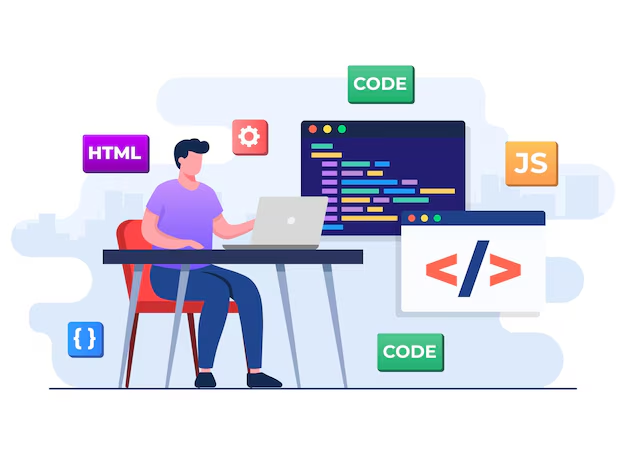
- SEO web development combines SEO principles with web development to create websites that are fast, user-friendly, and easier for search engines to understand.
- In this guide, you’ll learn what SEO web development is, why it matters, and the key elements that help build a website capable of performing better in search results.
Table of Contents
What Is SEO Web Development and Why Does It Matter?
SEO web development is the practice of building a website so search engines can easily find, crawl, and understand it. Instead of just making a site look pretty, it builds SEO directly into the code—focusing on fast load speeds, mobile-friendly design, clean code structure, and secure connections (HTTPS).It matters because you can have the most beautiful website in the world, but if search engines can’t read it, your customers won’t find it. Doing it right from the start gives your site a massive head start in ranking higher, driving free traffic, and converting visitors into customers.
What Are the Essential Elements of an SEO-Friendly Website Development Process?
Building an SEO-friendly site means designing it to be easily understood by search engines from the start. This involves integrating technical optimizations into your site’s structure and code right away. The goal? To rank higher while staying super fast and smooth for real users too.
1. Server-Side Rendering & Crawlability
The Depth: Search engine bots often choke on heavy, client-side JavaScript frameworks. If a bot hits an empty shell, it can leave your pages looking completely blank to their crawlers.
The Focus: Switch to Server-Side Rendering (SSR) or Static Site Generation (SSG). This pre-renders your code into clean HTML right on the server, ensuring search engine spiders instantly read and index your full content the second they arrive.
2. Core Web Vitals & Speed Optimization
The Depth: Google actively tanks the rankings of slow-loading websites and penalizes interfaces where text and elements abruptly jump around while images load.
The Focus: Clear out your critical rendering path by deferring non-essential scripts. Always hardcode explicit aspect ratio dimensions into your image tags to completely wipe out Cumulative Layout Shift (CLS) and keep your Time to First Byte (TTFB) fast.
3. Semantic HTML & Document Architecture
The Depth: Algorithms don’t look at web pages visually like we do; they rely entirely on your underlying code structure to figure out which pieces of information actually matter most.
The Focus: Ditch the endless, generic <div> containers and use meaningful semantic elements like <main>, <article>, and <section>. Stick to a logical heading layout: use exactly one <h1> for your title, followed by sequential <h2> and <h3> tags.
4. Canonicalization & Indexing Controls
The Depth: E-commerce sorting filters and messy tracking URLs constantly trigger duplicate content loops. This traps search bots and wastes your limited crawl budget on the wrong pages.
The Focus: Deploy self-referential rel=”canonical” tags to point search bots back to the single master version of a URL. Pair this with a tight robots.txt file to block crawlers from indexing duplicate pages or private staging zones.
5. Structured Data JSON-LD Schemas
The Depth: Search engine algorithms are incredibly smart, but using explicit, formatted data maps out exactly what your content means without any guesswork.
The Focus: Inject structured JSON-LD scripts directly into your document headers. This instantly translates your page into clean, machine-readable data, helping you win eye-catching rich snippets, review stars, and FAQ dropdowns right on the search results page.
6. Mobile-First Responsive Design
The Depth: Google relies entirely on mobile-first indexing. That means its algorithm evaluates and ranks your entire website based purely on how well it performs and loads on a smartphone.
The Focus: Build fluid, flexible grid systems using modern CSS. Double-check that all buttons, menus, and media files dynamically scale so users don’t deal with broken layouts or annoying horizontal scrolling on smaller screens.
7. Global HTTPS & Server Security
The Depth: User safety is a massive, foundational ranking factor. Modern browsers will openly flag any unencrypted http:// sites as “Not Secure,” which instantly kills visitor trust and tanks your visibility.
The Focus: Install an SSL certificate to ensure your entire site loads over a secure HTTPS connection. Set up bulletproof server-side redirects to automatically force all old, unsecured traffic directly over to the safe, secure version.
How Can Web Developers Implement SEO Best Practices During Development?
1. Optimize Time to First Byte (TTFB)
- The Practical Implementation: Front-end tricks won’t save a site if the server takes too long to respond. You need to speed up how your backend talks to the database and caches raw resources.
- The Execution: Set up object caching like Redis to store frequent database queries. Optimize your database indexes, and deploy an edge CDN to serve static assets instantly to global users.
2. Automate Dynamic XML Sitemaps
- The Practical Implementation: Stop updating static XML files by hand when new content goes live. Build an automated generator directly into your backend routing framework to talk to search bots.
- The Execution: Write a script that hooks into your database or CMS API. Have it update your sitemap.xml automatically whenever pages change, and make sure it filters out noindex or duplicate links.
3. Clean Up Your Robots.txt Rules
- The Practical Implementation: Don’t let search bots waste their limited crawl time on junk pages. You must explicitly block them from private, broken, or low-value areas of your hosting server.
- The Execution: Place a strict robots.txt file in your root directory. Use clear Disallow rules to block bots from admin dashboards, backend plugins, and internal search result URLs.
4. Create Smart Error and Link Handlers
- The Practical Implementation: Dead links or internal server crashes break user trust and stop search indexing. Build a reliable fallback route to catch and handle these broken links cleanly.
- The Execution: Set up global error-boundary routes to catch broken links. Make sure your server returns a true HTTP 404 status code (not a soft 404), and log these bugs to a tracking dashboard for fast fixes.
5. Standardize Hreflang Logic for Global Sites
- The Practical Implementation: When serving users in different regions, search engines can easily mistake your translated pages for duplicate spam. You must inject clear language targets into your layout template.
- The Execution: Build backend middleware that automatically loops through your page variants. Output accurate <link rel=”alternate” hreflang=”x”> tags in the document header, and always add an x-default fallback tag.
Why Do Many Websites Fail to Rank Despite Investing in SEO and Web Development?
1. Spending on SEO But Rankings Are Not Moving
Money goes in, months pass, and rankings stay stuck. Usually the strategy is chasing wrong keywords or ignoring what searchers actually want. No amount of technical work fixes a direction problem — getting the foundation right has to come before anything else delivers results.
2. Website Looks Great But Nobody Is Finding It
The design gets compliments, but organic traffic never shows up. Search engines need logical structure and crawlable content to rank pages — not just attractive visuals. When a site looks polished but lacks clear architecture, search engines simply skip over it, no matter how good it looks.
3. Publishing Content Regularly But Still Not Attracting the Right Visitors
Articles go live every week, yet traffic stays flat or irrelevant. Writing about what the business wants to say, rather than what people are actually Googling, is the core mistake. Content that misses real search queries brings the wrong audience — or no audience at all.
4. Bigger Competitors Dominate Every Keyword Worth Targeting
Page one is locked up by sites that have been building authority for years. Going head-to-head with them on broad keywords drains the budget fast. Targeting specific, lower-competition topics is a smarter entry point — smaller wins stack up, authority grows, and ranking on harder terms becomes realistic over time.
5. Hidden Technical Problems Silently Killing Rankings
Traffic drops gradually and nobody can pinpoint why. Crawl errors, slow load times, broken links, and duplicate pages quietly chip away at rankings every day. These issues rarely announce themselves — they just accumulate. Catching them through regular audits is far less painful than untangling months of compounding damage later.
6. Losing Faith Because Results Are Taking Too Long
A few months in with nothing visible to show — that’s when most businesses start pulling back. But SEO builds quietly before it shows. Momentum tends to arrive right after people give up. Staying consistent through that frustrating window is genuinely one of the biggest competitive edges available.
7. Despite Publishing Content, the Website Still Lacks Authority
A growing content library but rankings remain shallow and weak. Volume alone never builds authority. Search engines look for genuine depth, strong internal connections between pages, and backlinks from credible sources. Without those signals working together, even a well-stocked blog struggles to earn meaningful visibility in competitive search results.
8. Creating More Content but Seeing Less Visibility
More posts go live, yet reach keeps shrinking. Publishing without a clear strategy fragments topical focus and leaves search engines unsure what the site actually stands for. More content only moves the needle when it targets genuine demand, fills real gaps, and builds on what already exists — not just adds to the pile.
9. Getting Traffic but Not Ranking for Revenue-Driving Keywords
Analytics show decent visitor numbers, but leads and sales stay low. That gap means the site ranks for informational searches, not buying ones. Aligning SEO web development efforts with high-intent keywords ensures the right audience lands on pages built to convert — not just browse and leave.
How Do You Choose the Right SEO Web Development Company for Your Business?
Factor to Evaluate | What to Look For | Why It Matters |
SEO Expertise | Experience with technical SEO, on-page SEO, and website optimization. | Ensures your website is built to meet search engine requirements from the start. |
Web Development Skills | Proficiency in modern development frameworks, responsive design, and performance optimization. | Helps create a fast, secure, and scalable website that supports SEO goals. |
Portfolio and Case Studies | Examples of previous projects and measurable SEO results. | Demonstrates the agency’s ability to deliver successful SEO-focused websites. |
Technical SEO Knowledge | Understanding of site architecture, indexing, schema markup, and Core Web Vitals. | Prevents technical issues that can negatively impact search visibility. |
Mobile Optimization Capabilities | Ability to build fully responsive and mobile-friendly websites. | Supports Google’s mobile-first indexing and improves user experience. |
Website Performance Focus | Expertise in improving page speed, server performance, and loading times. | Faster websites typically achieve better engagement and search rankings. |
Communication and Transparency | Clear reporting, regular updates, and defined project timelines. | Ensures alignment between business objectives and development progress. |
Content and CMS Flexibility | Experience with SEO-friendly content management systems and customization. | Makes it easier to manage, update, and optimize content over time. |
Final thought
SEO web development is about building a website that works well for both users and search engines. When SEO is considered from the start, it becomes easier to improve visibility, user experience, and long-term performance without relying solely on content updates or backlinks. If you’re planning a new website or improving an existing one, investing in SEO web development can help create a stronger foundation for sustainable search growth.
FAQs
What Is the Difference Between Web Development and SEO?
Web development is about building and upkeep of a site’s design and tech guts. SEO? It’s tweaking content, structure, and tech bits to boost ranking and visibility in searches. So, both matter a lot, yet focus on different things.
How Can Developers Make a Website Easier for Search Engines to Crawl and Index?
To boost what crawlers can find, developers should create XML sitemaps and organize sites logically. Using friendly URLs, optimizing internal linking, and properly setting up robots.txt and canonical tags helps too – it guides the crawlers nicely.
Which Web Development Factors Have the Biggest Impact on SEO Performance?
Speed, mobile friendliness, Core Web Vitals, secure HTTPS, good site structure, and clean code really boost SEO. They let search engines crawl sites easier while enhancing how users experience the site – win-win, right?
What Technical SEO Issues Should Be Fixed Before Launching a Website?
Before launching, developers need to fix broken links, redirect errors, and duplicate content. Also, they should check for missing metadata, crawlability issues, slow-loading pages, and indexing mistakes. Plus, verifying XML sitemaps, robots.txt settings, and analytics tracking is important too.
Why Do Some Well-Designed Websites Struggle to Rank on Google?
Even if a site looks great, it might not rank well if it doesn’t have good SEO content or has problems like loading slowly, having tech issues, offering bad mobile views, or neglecting on-page and technical SEO stuff.

Tarun Singh is an SEO & Digital Growth Strategist with 5+ years of experience driving organic traffic, search visibility, and revenue growth for eCommerce, SaaS, and enterprise brands. His expertise includes technical SEO, AI-driven marketing, keyword strategy, content optimization, and scalable growth campaigns focused on improving rankings, authority, and business performance.